How to Conduct a Proven Audit of a Medical-Legal Guest Post Site Before Buying
Knowing what to check on a prospective medical-legal guest post site is only half the problem. Additionally, the guest post vetting checklist covers that ground.
Moreover, How to Audit a Medical-Legal Guest Post Site Before Buying teaches you to run the audit efficiently with tools. Before you draft a pitch, avoid paid placements that fail basic scrutiny.
This is a process guide, not a checklist repeat: the actual step-by-step workflow for auditing a medical-legal guest post prospect, the specific tools involved, and a reverse-engineering tactic that surfaces proven, already-accepting sites instead of cold-searching for “write for us” pages one at a time.
Step One: Reverse-Engineer Competitors’ Backlinks Instead of Cold Searching
Rather than starting with generic medical malpractice write for us searches, use a faster approach.
How to Audit a Medical-Legal Guest Post Site Before Buying guides this process.
Start by pulling a competitor’s backlink profile with a tool like Ahrefs or Semrush.
Then filter those referring domains by anchor text patterns signaling a guest post relationship.
Look for anchors or surrounding link context containing phrases like ‘guest post’, ‘contributor’, or ‘author bio’.
This surfaces sites that have already demonstrated a willingness to accept medical-legal or health-adjacent contributed content, rather than sites that merely list generic submission guidelines without a track record of actually publishing them. Exporting this filtered list, sorted by domain rating and cross-referenced against genuine health or legal-medical relevance, produces a working prospect list considerably faster than manually searching for open submission pages one at a time.
Step Two: Verify Traffic Independently, Not Just Domain Authority
Before any deeper review, pull the prospect’s estimated organic traffic through a standalone tool check — this is the single fastest filter for eliminating sites with inflated authority scores but minimal genuine readership. A domain authority checker alone doesn’t reveal this gap; traffic verification is a separate, necessary step.
A meaningful mismatch — a high authority score paired with negligible estimated traffic — is one of the clearest, fastest signals to eliminate a prospect before investing further audit time. Sites passing this initial filter move to the next stage; sites failing it can generally be discarded immediately without further review.
Step Three: Run a Spam Score and Outbound Link Check
For sites clearing the traffic filter, the next step checks the site’s spam signal profile and outbound link neighborhood. A spam score checker tool provides a quick composite read, while a manual review of several recent articles’ outbound links reveals whether the site behaves like a link farm — linking indiscriminately across unrelated commercial categories — or like a genuine publication with a coherent, relevant outbound link pattern.
For medical-legal content specifically, this step should also specifically check for the healthcare-targeted spam patterns covered elsewhere in this cluster — foreign pharmacy references, unrelated supplement promotion, or automatically-generated pharmaceutical content mixed in among otherwise legitimate-looking articles.
Step Four: Confirm Named, Credentialed Authorship
This is the step most general link-vetting processes skip, and it’s specifically why medical-legal auditing requires more than a standard backlink tool workflow. Review five to ten of the site’s existing health-adjacent articles specifically for named author bylines with visible, verifiable credentials — not generic “Editorial Team” or “Staff Writer” attribution.
Current industry guidance on this point is direct: guest posts carrying genuine author credentials — MD, RN, RD, CPT, or equivalent — in the byline consistently outperform anonymous or generic-author placements in this niche, reflecting how directly Google’s health-content quality evaluation weighs this signal specifically. A site that can’t demonstrate this pattern across its existing content is a weaker candidate regardless of how well it performed on the earlier steps.
Step Five: Check Editorial Difficulty as a Quality Signal
Counterintuitively, a site’s submission difficulty is itself a useful audit signal. Sites with the most rigorous, selective application and editorial review processes tend to be exactly the sites carrying the most genuine authority and trust — the difficulty itself reflects genuine editorial standards rather than an arbitrary barrier.
Practically, this means a site offering instant or near-instant placement for a flat fee with no meaningful review process should be treated with more suspicion, not less, than a site requiring writing samples, editorial review, and a multi-week response time. The friction is often the signal, not an inconvenience to route around.
Step Six: Confirm Sponsored Content Disclosure Compliance If Payment Is Involved
For any placement involving payment, verify the site properly applies sponsored content disclosure — typically rel="sponsored" tagging — on paid health-adjacent content. A site offering to disguise a paid placement as fully organic editorial content is taking on compliance risk that ultimately affects the safety and value of the link itself, connecting directly to the broader link-scheme compliance distinction relevant to any guest posting arrangement.
A Worked Example: Running the Full Process on a Real Prospect
Walking through this concretely makes the sequence easier to apply. Starting from step one, pulling a comparable specialist firm’s backlink profile and filtering by guest-post-signal anchor text surfaces a healthcare-focused publication with a domain rating around 45.
Moving to step two, checking estimated traffic shows genuine, consistent monthly visitors in the low thousands — a reasonable match for the authority level, clearing the first real filter. Step three’s spam and outbound link check shows a clean pattern: outbound links point primarily to other health publications, hospital systems, and a few relevant legal resources, with no signs of the pharmaceutical spam pattern covered elsewhere in this cluster.
Step four’s authorship check reveals a mix — several recent articles carry named RN or healthcare-administration bylines, but two older pieces show only generic “Staff” attribution. This is a partial pass worth noting rather than an automatic disqualification: the site’s current standards appear to have improved over time, and a firm could reasonably request the new placement specifically carry proper credentialed attribution as a condition of moving forward.
Step five’s friction check shows the site requires writing samples and a two-week review window before accepting new contributors — a positive signal per the framework above, not a deterrent. Step six confirms the site properly applies sponsored disclosure tagging on its existing paid content, visible by inspecting a few recent sponsored posts directly.
Weighing all six steps together, this prospect clears the bar as a strong candidate, with one specific negotiation point (requesting credentialed authorship on the new piece specifically) worth raising before finalizing the arrangement — exactly the kind of nuanced, evidence-based outcome this process is designed to produce rather than a simple pass or fail.
Tool-Specific Notes for Each Step
For firms without an existing premium SEO tool subscription, several steps in this process have accessible free or low-cost alternatives worth knowing. Step one’s anchor-text filtering works best with a paid Ahrefs or Semrush subscription, but a scaled-down version is achievable through Google’s site-specific search operators combined with terms like “guest post” or “contributor,” as covered in the FAQ below. Step two’s traffic verification has reasonably capable free options, including browser extensions that provide rough traffic estimates directly while browsing a prospect’s site. Step three’s spam score checking is available through several free-tier tools, though the outbound link neighborhood review itself requires manual reading rather than an automated check. Steps four through six require manual review regardless of budget, since no tool can substitute for actually reading a site’s content and verifying its disclosed practices directly.
Common Mistakes That Undermine This Process
Stopping the audit after step two because traffic looks reasonable. Traffic verification alone doesn’t catch spam patterns, authorship gaps, or disclosure issues — it’s a necessary early filter, not a complete audit on its own, and treating it as sufficient is one of the most common ways a genuinely flawed prospect slips through.
Treating a single passing article as representative of the whole site’s standards. Reviewing only one or two articles before making a credentialed-authorship determination risks missing inconsistency across the site’s broader content — the recommended five to ten article sample in step four exists specifically to catch this kind of unevenness.
Rebuilding the reverse-engineered prospect list from scratch for every new campaign rather than maintaining and refreshing it. Step one’s competitor backlink analysis produces reusable value over time; treating it as a one-off exercise for a single campaign rather than an ongoing, periodically refreshed resource wastes the setup investment it required.
Why “If a Vendor Won’t Publish for Fifty Dollars, It’s Not Worth It” Gets It Backwards
Current industry commentary on this space frames the risk directly: a guest post vendor willing to publish anything for fifty dollars will produce a placement that ranks for nothing. This is worth sitting with, because it inverts the intuitive cost logic most firms bring to link building decisions. The instinct is to treat a lower price as a better deal; the reality this six-step process is built to surface is that an unusually low price is frequently the clearest available signal that a prospect will fail one or more of the six checks above, particularly steps two through four.
This connects directly to why step five’s friction principle matters so much — a genuinely rigorous site simply cannot operate at the price point a fifty-dollar placement implies, since the editorial review, credentialing verification, and genuine traffic a passing site requires all cost real time and money to maintain. Price and process rigor aren’t independent variables; they’re structurally linked, which is exactly why an unusually cheap prospect deserves more scrutiny through this process, not less.
Building This Process Into a Repeatable Team Workflow
For a firm running this audit process regularly rather than as a one-off exercise, documenting the six steps as a shared checklist or lightweight internal tool — even something as simple as a shared spreadsheet with columns for each step’s pass/fail status — makes the process genuinely repeatable across whoever on the team is handling outreach in a given month, rather than depending entirely on one person’s institutional memory of what to check and in what order.
This documentation also creates a useful audit trail: if a placement later turns out to underperform or, in a worse case, needs to be reconsidered for toxic-link concerns down the line, having a record of which steps it passed and when provides genuinely useful context for understanding what happened and whether the vetting process itself needs adjustment going forward.
Over time, this kind of documented process also becomes a genuine differentiator when a firm is evaluating whether to bring link building in-house versus working with an outside provider or brokerage. A firm that has internalized a repeatable, documented six-step process is in a much stronger position to evaluate whether a prospective provider’s own vetting rigor actually matches or exceeds what the firm could verify independently — turning this guide’s process from a one-time audit tool into a lasting internal capability and evaluation standard.
Putting the Six-Step Process Together
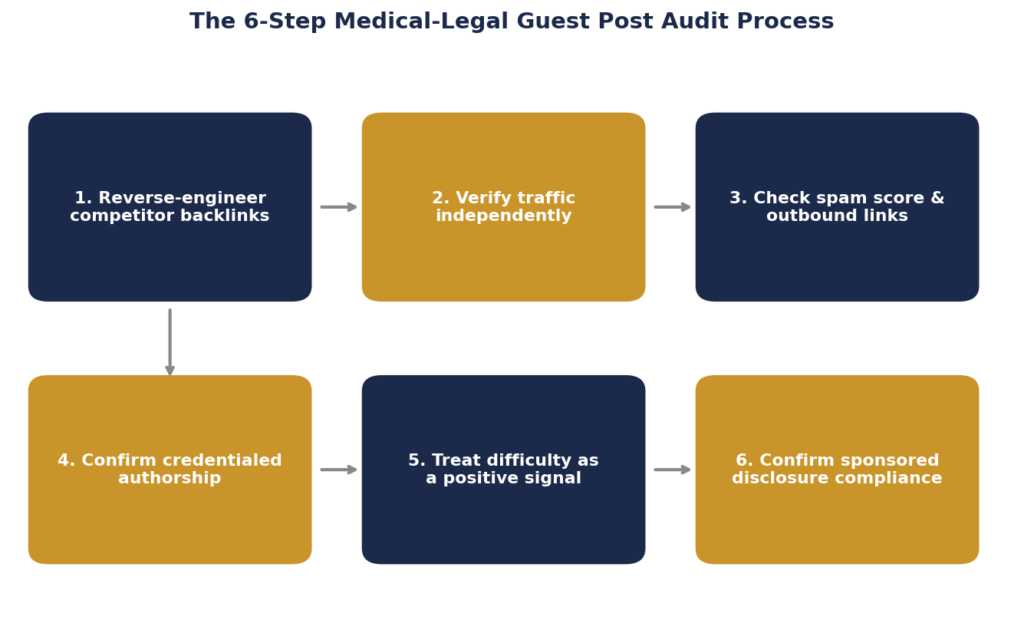
In sequence: reverse-engineer competitor backlinks filtered by guest-post-signal anchor text to build an initial prospect list; verify traffic independently rather than trusting authority score alone; check spam signals and outbound link neighborhood, including healthcare-specific spam patterns; confirm named, credentialed authorship across existing content; treat genuine editorial difficulty as a positive signal rather than an obstacle; and confirm sponsored disclosure compliance before any paid arrangement proceeds.
A prospect clearing all six steps represents a genuinely well-vetted placement opportunity. A prospect failing any single step, particularly steps two through four, deserves either elimination or, if the opportunity seems otherwise strong, a direct conversation with the publisher addressing the specific gap before proceeding.
Why Quality-First Auditing Pays Off Even at Higher Per-Placement Cost
The audit time this process requires is worth weighing against what current industry data confirms about the payoff: one genuine health backlink from a high-authority, US-based, properly vetted site is worth meaningfully more than a dozen links from generic, low-authority blogs, on a pure ranking-impact basis. This reinforces why the six-step process above is worth the time investment it requires relative to a faster but shallower vetting pass — the entire economic case for medical-legal link building depends on placements clearing a genuinely higher bar than general legal content requires.
Frequently Asked Questions
How long does this six-step audit process typically take per prospect?
Roughly 20-40 minutes per site once the reverse-engineered prospect list from step one is built, since steps two and three can be checked quickly with standard tools, while steps four and five require closer manual content review. Building the initial prospect list itself is a one-time setup investment that then supplies multiple candidates for repeated use of the remaining steps.
Should every prospect go through all six steps, or can some be skipped for efficiency?
All six steps should apply to any prospect being seriously considered for payment, since skipping any single step — particularly the credentialed authorship check in step four — is exactly how a seemingly strong prospect turns out to carry real underlying risk that a faster, partial audit would have missed.
What’s the fastest way to build an initial prospect list without paying for a premium SEO tool subscription?
Google’s own advanced search operators can approximate the anchor-text filtering described in step one, searching site content for combinations of health or legal terms alongside phrases like “guest post” or “write for us,” though this is less precise and more time-consuming than a dedicated backlink tool’s direct anchor-text filtering capability.
Is it worth pursuing a prospect that fails step five (offers instant, low-friction placement) if it otherwise passes every other check?
This deserves real caution rather than automatic disqualification. A site passing every other check but offering unusually low-friction, instant placement is a genuine outlier worth investigating further before proceeding — it’s possible, though less common, for a legitimately well-run site to simply have an efficient process, but this pattern correlates strongly enough with lower-quality operations that extra scrutiny is warranted.
How often should a firm’s prospect list from step one be refreshed with new reverse-engineered candidates?
Quarterly refreshes work well for most firms, since competitor backlink profiles evolve gradually and a quarterly re-pull captures new guest-post-accepting sites without requiring constant, resource-intensive monitoring.
Does this six-step process differ meaningfully from the general guest post vetting checklist covered elsewhere in this cluster?
Yes — the checklist explains what specifically to look for; this guide explains how to actually execute that evaluation efficiently using real tools and a specific sequence, including the reverse-engineering tactic in step one that isn’t part of the criteria-focused checklist itself. Use both together: this process to build and work through prospects, the checklist to confirm each specific criterion along the way.
Can this same six-step process be adapted for auditing editorial or digital PR opportunities rather than paid guest posts?
Largely yes, with step six naturally not applying since no payment or sponsored disclosure is involved in genuine earned editorial coverage. Steps one through five remain directly relevant — verifying traffic, checking spam and outbound link patterns, and confirming credentialed authorship all matter just as much when evaluating whether a publication is a worthwhile target for a digital PR pitch or journalist query response.
Who on a firm’s team should typically own running this audit process — marketing staff, an attorney, or an outside provider?
This varies by firm size and resourcing, but the process doesn’t require legal expertise to execute correctly — a marketing coordinator or in-house team member with basic familiarity with SEO tools can run steps one through three and much of step six independently, while step four’s credentialed authorship verification and step five’s editorial-difficulty judgment benefit from someone with genuine familiarity with what quality medical-legal content actually looks like, whether that’s an attorney reviewing spot-checks or an experienced marketing lead.
The Bottom Line
Knowing what makes a medical-legal guest post site trustworthy only helps if a firm can actually audit prospects efficiently rather than spending disproportionate time on sites that fail basic scrutiny. The six-step process here — reverse-engineering competitor backlinks, verifying traffic independently, checking spam and outbound link patterns, confirming credentialed authorship, treating editorial difficulty as a positive signal, and verifying disclosure compliance — turns vetting from a vague, time-consuming judgment call into a repeatable workflow that surfaces genuinely strong placements faster than cold-searching for open submission pages ever could.