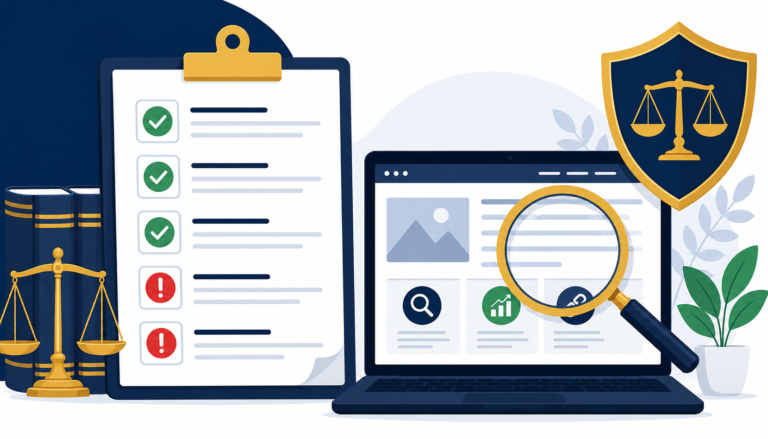
Guest Post Vetting Checklist for PI Firms : what to Check Before You Pay
This guest post vetting checklist for personal injury firms covers everything you need to verify before approving a placement — from domain metrics to red flags most PI firms miss.” Before your personal injury firm buys a guest post placement, run this checklist. Covers domain metrics, traffic quality, niche relevance, link profile, and red flags to avoid.Guest Post Vetting Checklist for PI Firms-
Personal injury is one of the most competitive niches in legal SEO. A single quality backlink from a well-placed guest post can move rankings. A bad one — bought without due diligence — can do the opposite, dragging your domain into Google’s spam filters and wasting budget that could have gone toward placements that actually work.
The problem is that most PI firms buying guest posts are doing it blind. They see a DR score, a price tag, and a “legal niche” label — and they pay. What they miss are the six or seven signals that separate a placement worth buying from one that looks good on paper but delivers nothing in terms of ranking valueThis checklist covers everything you need to verify before approving a guest post placement for your personal injury firm. Use it every time, without exception
1. Confirm the Site Has Genuine Organic Traffic
Domain Rating is not traffic. A site can have a DR of 45 and receive fewer than 200 monthly visitors — which means your link is sitting on a page nobody reads and Google barely crawls with any priority.
Before paying, check the site’s organic traffic using a free estimate tool such as Ubersuggest or Similarweb. You are looking for:
- Minimum 1,000 monthly organic visitors for a standard placement
- Traffic that has been stable or growing over the past six months — not a site that spiked once and flatlined
- Traffic from the US — if the majority of visitors are from India, Pakistan, or the Philippines on a site claiming to serve American legal audiences, that is a red flag regardless of the DR
A site with genuine organic traffic has earned Google’s trust organically. That trust transfers — partially — to every outbound link it carries.
2. Check Niche Relevance, Not Just “Legal Adjacent”
Many link brokers will offer placements on sites they describe as “legal niche” when the site actually covers personal finance, general business, health, or lifestyle with a single legal category bolted on. For PI firms specifically, topical relevance matters more than it did three years ago.
Google’s algorithms in 2026 weight link relevance heavily. A backlink from a site focused on personal injury law, accident claims, or legal consumer rights passes more value than a link from a general blog that happens to have published two law-related posts this year.
When vetting a site, ask:
- Does the homepage or about page clearly position this site within the legal space?
- Does the blog consistently publish legal content, or is law one of fifteen categories?
- Are there other PI or legal-adjacent articles already indexed on the site?
If the answer to any of these is no, the placement is not worth PI-rate pricing — and you should either negotiate down or pass.
3. Review the Existing Link Profile for Spam Patterns
The site you are buying a placement on has its own backlink profile. If that profile is dirty, your link is being hosted on a domain Google already views with suspicion.
Run the site through a free backlink checker — Ahrefs’ free version, Moz Link Explorer, or even a quick Google search for the domain’s referring domains. Watch for:
- A spike of backlinks acquired in a short window — this is a sign of a link scheme, not organic growth
- Referring domains that are clearly foreign-language spam sites or irrelevant directories
- A high ratio of exact-match anchor text pointing to the site itself, which suggests someone has been over-optimizing it
- Links from adult, gambling, or pharmaceutical sites — these are disqualifiers regardless of the site’s other metrics
A clean referring domain profile — diverse, growing steadily, and from relevant or neutral sources — is one of the strongest signs of a legitimate publisher.
4. Verify the Site Is Actually Indexed and Crawled Regularly
This sounds basic but it gets missed. Before paying for any placement, type site:domainname.com into Google and check:
- Are the site’s pages appearing in Google’s index at all?
- How many pages are indexed? A site with 300 published posts but only 40 indexed pages has a crawlability problem
- When was the most recent post indexed? If the last indexed article is from four months ago, Google has deprioritised the site’s crawl budget
You can also check the live URL inspection tool in Google Search Console if the broker gives you access — though most won’t. The site: operator gives you enough to make
5. Assess the Quality and Depth of Existing Content
Google evaluates content quality at the domain level. If the site hosting your guest post is full of thin, AI-generated 400-word posts stuffed with keywords, your placement is on a site Google already associates with low-quality content — and that association matters.
Before approving, read three to five existing posts on the site. Ask:
- Are they written to a standard a PI firm would be comfortable associating with?
- Do they demonstrate any real knowledge of legal topics, or are they surface-level rewrites?
- Do they cite sources, link to authoritative references, and have named authors?
- Are there author bios with credentials, or is every post attributed to “admin” or “editorial team”?
E-E-A-T (Experience, Expertise, Authoritativeness, Trustworthiness) signals apply to the entire domain, not just individual pages. A site with poor content quality across the board is not a site that will add meaningful authority to your PI firm’s backlink profil
6. Check Outbound Link Patterns on the Site
Some sites function as link farms in disguise — they publish content that appears normal but contains heavy outbound linking to unrelated commercial sites, often in patterns that are clearly paid. If the site you are evaluating has posts with five or six do-follow links to unrelated businesses embedded in the body copy, it has almost certainly been flagged by Google’s SpamBrain system.
Look at five to ten existing posts and count outbound links. A legitimate editorial site might have one or two contextual external links per post. A link farm will have four, five, or more — often to sites in unrelated industries like supplements, fintech, or offshore services.
This is one of the fastest ways to disqualify a site before you even get to pricing
7. Confirm Do-Follow Status and Link Placement Polic
This is non-negotiable: your guest post placement must include a do-follow link. No-follow links from guest posts deliver minimal SEO value and should be priced accordingly — typically 60 to 80 percent less than a do-follow equivalent.
Before paying, confirm in writing:
- The link will be do-follow (not no-follow, not sponsored-tagged)
- The link will be placed within the body of the article, not only in the author bio
- The anchor text will be agreed in advance and not changed post-publication
- The post will remain live for a minimum period (ask for a minimum of 12 months — ideally indefinitely)
Any broker or publisher who cannot confirm these points in writing is not a professional partner. Move on
8. Run a Final Red Flag Check
Before approving any placement, run through this final list. If you hit more than one of these, decline:
- The site was registered less than 12 months ago
- The site has no contact page, no about page, or no identifiable editorial team
- The broker cannot tell you the site’s monthly traffic figure
- The pricing seems unusually low for the claimed metrics (DR 50+ sites do not sell placements for $30)
- The site has a “write for us” page with no editorial standards listed
- The site publishes content across completely unrelated niches (legal, pets, travel, crypto — all on one domain)
- The broker pressures you to decide within 24 hours without sharing full site details
Making the Checklist Work in Practice
Vetting every placement manually takes time. The practical approach for most PI firms is to run this checklist once thoroughly when evaluating a new publisher or broker relationship, then spot-check subsequent placements from the same source rather than starting from scratch each time.
The alternative — skipping due diligence to save 20 minutes — is how PI firms end up with a backlink profile full of placements that provide no ranking value, or worse, attract a manual penalty during a Google spam update.
If you want placements that have already been vetted against every point in this checklist, LegallyRank sources and reviews all publisher sites before offering them to PI firm clients. Explore our personal injury guest post packages or contact us to discuss your firm’s link building requirements
Building links for your personal injury firm without a vetting process is not link building — it is link gambling. Use the checklist above every time, and you will avoid the placements that look good on paper but deliver nothing where it counts.