How to Build Links for a Brand New Personal Injury Law Firm Website
If you’ve just launched a personal injury law firm website, most link building advice you’ll find online isn’t actually written for you. It assumes you already have some domain authority, a handful of existing backlinks, and an established reputation to leverage. It tells you to “get quoted by journalists” or “build relationships with legal bloggers” without addressing the actual problem: nobody links to a site that didn’t exist last month, and no journalist is quoting a firm with zero online footprint.
This guide is written specifically for that starting point — a brand-new PI firm website with zero backlinks and zero domain authority — and lays out the actual sequence that works, rather than a generic tactics list that assumes you’re further along than you are.
Why Generic Link Building Advice Fails a Brand-New Domain
Most law firm link building guides recommend the same handful of tactics: guest posting, digital PR, journalist outreach, earning citations from legal publications. These are all legitimate — but they share a hidden assumption. Guest post opportunities on decent sites usually require you to demonstrate some existing authority before an editor accepts your pitch. Journalists responding to expert-source requests skim your site before quoting you, and a domain with zero history reads as unproven.
None of this means these tactics don’t eventually work for a new firm — it means there’s a sequencing problem most advice skips over. You can’t jump straight to earning high-authority editorial links before building the baseline foundation that makes those links possible to earn.
The Actual Starting Sequence for a Zero-Authority Domain
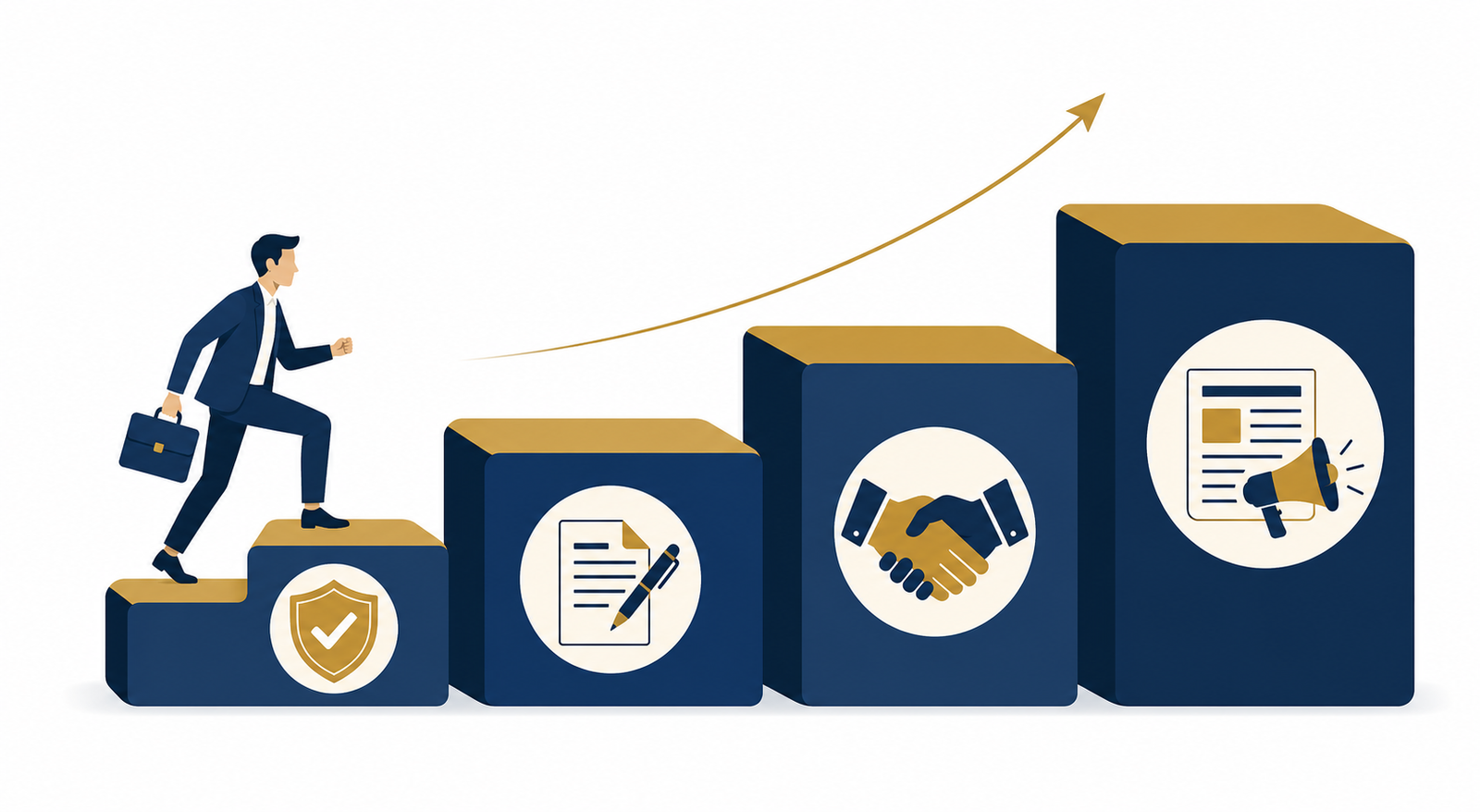
Stage 1: Foundational Trust Signals (Weeks 1-2)
- Google Business Profile — claimed, verified, fully filled out with practice areas, service area, and real photos
- Core legal directories — Avvo, Justia, FindLaw, and Martindale-Hubbell. These are foundational specifically because competitors already have them
- NAP consistency — Name, Address, Phone matching exactly across every listing
This stage doesn’t produce high-value backlinks on its own, but it establishes the baseline legitimacy that makes every subsequent tactic more credible.
Stage 2: Publish Content Worth Linking To (Weeks 2-6)
Nobody links to a thin, generic homepage. A content cluster of genuinely useful, specific guides gives you something worth referencing — enough depth that a publisher or journalist reviewing your site sees real expertise, not a placeholder. Resist publishing volume just to hit a page count; a smaller number of thorough pages builds more credibility than a larger number of shallow ones.
Stage 3: Low-Barrier Earned Links (Weeks 4-8, overlapping Stage 2)
Local and community links. Chamber of commerce membership, sponsorships, and scholarship programs don’t require existing authority — a legitimate local relationship is the qualifying factor, not domain age.
Unlinked brand mention recovery. If your firm’s been mentioned anywhere without a link, requesting one added is a fast, low-resistance win since the site already chose to mention you once.
HARO-style expert source responses. Journalist query platforms let a new firm compete on answer quality rather than existing domain authority.
Stage 4: Guest Posting and Editorial Outreach (Month 2 onward)
Once you have a genuine content cluster and baseline directory/local presence, guest posting becomes realistic — you now have a portfolio to point to, and a site that doesn’t read as empty when an editor checks it before accepting a pitch. This is also where a vetted guest post brokerage becomes genuinely useful rather than premature.
A Closer Look at Each Stage
Stage 1 in practice: A merely-claimed Google Business Profile barely moves the needle. Fully completing it means every relevant practice area as a service category, real photos, a complete business description, and accurate hours. The same applies to core legal directories — attorney bios and full practice-area detail signal far more credibility than a bare listing.
Stage 2 in practice: When a publisher evaluates whether to link to your firm, they’re implicitly asking whether your site shows real subject-matter depth. A working content cluster includes buyer-education content, practice-area detail beyond a template services page, and consistent publishing that shows the site is active.
Stage 3 in practice: Local links work best pursued as genuine community involvement rather than a transactional purchase — committee participation earns better, more durable placement than a one-time membership fee. For brand mention recovery, search your firm’s and attorneys’ names periodically and send a brief request wherever a mention lacks a link.
Stage 4 in practice: An outreach pitch should reference specific content already on your site rather than asking an editor to take your expertise on faith.
Common Early Mistakes Worth Naming Directly
Treating directory submissions as one-time rather than ongoing. Office moves, phone changes, new attorneys — NAP inconsistency undermines the very trust signal these listings are meant to build. A quarterly audit catches drift early.
Publishing a content cluster with no internal linking structure. Pages that don’t reference each other miss an easy, low-risk way to reinforce topical relevance while external link building ramps up.
Assuming all early links must point at the homepage. Directing some to specific practice-area pages, once they exist and are optimized, gives Google a clearer signal about which pages should rank for which terms.
Underestimating how long Stages 1 and 2 genuinely take. Rushing to guest posting sooner usually backfires, since later tactics depend on the earlier ones actually being in place.
Tools Worth Using to Track Progress
A simple free stack is enough at this stage: Google Search Console to monitor indexing and impressions, a free spreadsheet to log which directories are submitted and confirmed live, and periodic manual searches of your firm’s name to catch unlinked mentions. Paid tools like Ahrefs or Semrush become more useful once you’re managing a larger, more complex profile in Stage 4.
A Realistic Timeline Expectation
Firms following this sequence typically complete foundational directory presence within 2-3 weeks, a genuine content cluster by weeks 6-8, and see first meaningful earned or guest post links land in month two. Measurable ranking movement typically shows up 6-12 weeks after links go live — meaning a realistic total timeline from zero to visible movement is roughly 4-5 months for a genuinely new domain in a competitive practice area like personal injury.
It’s worth setting this expectation internally, especially if leadership is used to paid search’s near-immediate visibility. Organic authority compounds slowly at first, then accelerates — firms that abandon the process during the slow early months, right before that inflection point, lose most of the value of the work already done.
How This Differs From Building Links for an Established Domain
An established domain with existing content and a real backlink profile can pursue higher-authority placements more aggressively and afford a faster link acquisition pace, since a larger existing profile absorbs new links more naturally than a near-empty one. The sequence in this guide is calibrated specifically for the zero-to-established transition — once Stages 1-3 are genuinely complete, the more aggressive tactics common in general law firm SEO advice become appropriate rather than premature.
Frequently Asked Questions
Can a brand-new law firm website realistically compete for backlinks against established competitors?
Yes, but not by using the same tactics simultaneously. A new site competes by building the foundational sequence quickly, then moving into the same editorial tactics established competitors use once groundwork is in place.
How many backlinks should a brand-new PI firm website have after three months?
No universal number, but a realistic range following this sequence is 15-30 total links by month three, weighted toward directories, citations, and a handful of early guest posts or local links.
Should a new firm hire a link building agency immediately, or wait?
It depends on the stage. An agency focused on guest post placement is most valuable once Stage 2 (content) is complete. Help with foundational directory work in Stage 1 can be useful from day one.
Is it risky for a new domain to get backlinks too quickly?
Yes, if velocity is unnatural relative to the site’s actual content and reputation. A sudden burst of links pointing at a near-empty site is a pattern spam detection systems are built to catch.
What’s the single highest-priority action for a firm launching this week?
Claim and fully complete your Google Business Profile and the four foundational legal directories before anything else — the fastest, lowest-effort action that closes the most obvious gap versus established competitors.
What if a competitor’s brand-new site seems to be ranking faster by skipping this sequence?
Be skeptical of apparent shortcuts. A competitor may be taking on risk that hasn’t caught up yet, may have hidden existing authority from a rebrand, or may be in a genuinely less competitive market. Matching their pace without knowing which explains it is a common way firms copy a risk they don’t understand.
The Bottom Line
Building links for a brand-new personal injury firm website isn’t about finding a shortcut around zero authority — it’s about following the right sequence so that disadvantage closes as quickly as it realistically can. Foundational trust signals first, genuine content second, low-barrier earned links third, editorial outreach once there’s a real site behind the pitch.