
Link Building for Law Firms: The Complete 2026 Guide
Ten links from ten different, credible sites will always outperform fifty links from a single source. That principle, echoed consistently across current 2026 legal SEO guidance, is the starting point for understanding link building for law firms — but the generic version of this advice treats every practice area identically, when the actual publisher landscape, compliance considerations, and content opportunities differ meaningfully depending on what a firm actually practices. This guide covers the complete framework, then goes deep on medical malpractice specifically as a case study in how genuine practice-area specialization changes the picture.
What Link Building for Law Firms Actually Means in 2026
Link building is the process of earning links from other websites that point back to a law firm’s own site — but in 2026, the goal isn’t accumulating volume, it’s building a backlink profile that supports trust, topical authority, and both traditional and AI-driven search visibility simultaneously. With over 86 percent of SEO professionals actively using link building as a core ranking strategy this year, a firm’s backlink profile functions as one of the clearest external credibility signals search engines use to evaluate whether legal advice on a site can be trusted.
This matters more for law firms than for most other industries because legal content falls under Google’s YMYL (Your Money or Your Life) classification, meaning the advice on a law firm’s site can directly affect someone’s finances, liberty, or legal standing. Google holds this content to a stricter evaluation standard than it does for lower-stakes business categories, and backlinks function as one of the primary external signals feeding that evaluation.
The Foundational Link Sources Every Law Firm Needs
Regardless of practice area, several link sources function as necessary baseline infrastructure. Legal directories — Avvo, Justia, Martindale-Hubbell, Best Lawyers — carry enormous inherent authority, and even a simple, complete profile registers as a genuine legitimacy signal to search engines. State and local bar association listings serve a similar function while adding professional credibility specific to a firm’s actual jurisdiction. Consistent NAP (Name, Address, Phone) citation data across every listing remains essential for local pack visibility, since inconsistency across these foundational sources actively undermines the trust signal they’re meant to establish.
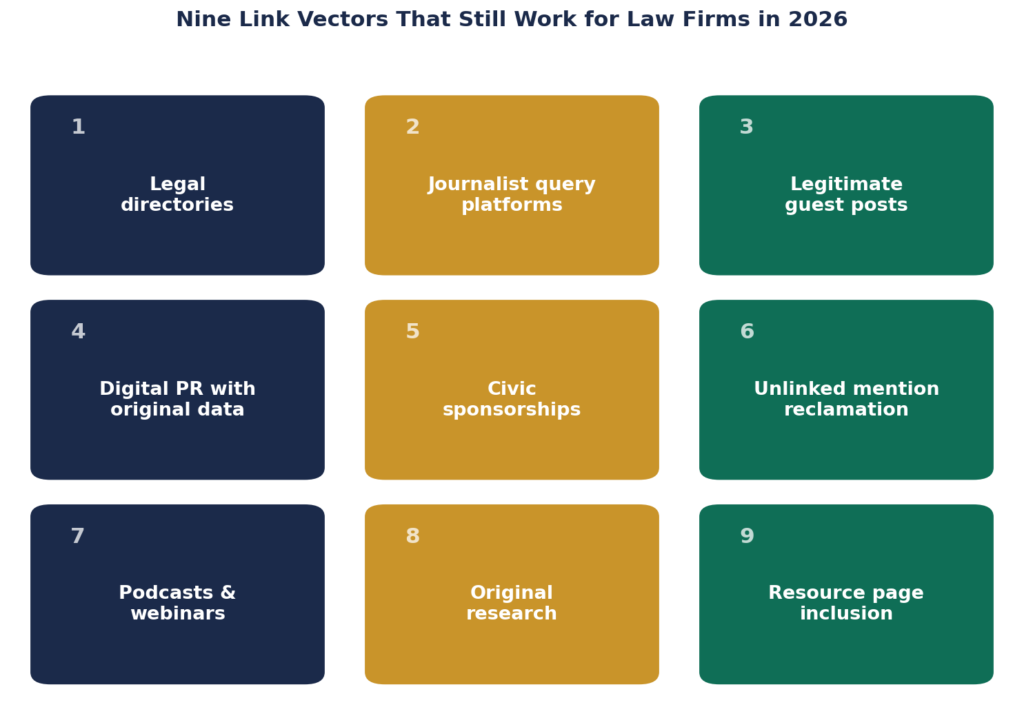
Nine Link Vectors That Still Move Rankings in 2026
Beyond the foundational layer, current legal SEO guidance converges on a consistent set of tactics that continue producing genuine results this year: legal directories, journalist source platforms (HARO-style query response, now operating under a fragmented multi-platform landscape), legitimate guest posting on genuinely relevant sites, digital PR campaigns built around original data, civic and community sponsorships, unlinked brand mention reclamation, podcast and webinar appearances, original research, and resource page inclusion on relevant institutional sites.
Not every vector applies equally to every practice area — this is exactly where genuine specialization matters more than a one-size-fits-all checklist, and it’s why the medical malpractice deep-dive later in this guide demonstrates how these same nine vectors get weighted and adapted differently once a firm’s actual practice focus is factored in.
Digital PR and Original Research: Where Raw Data Sources Matter
One of the more advanced, currently underutilized tactics involves data journalism — building content and outreach around raw government or judicial data sources rather than restating already-published “trends” content. For law firms specifically, several public data sources offer genuine original-research potential: the National Highway Traffic Safety Administration’s FARS database for accident data, PACER for federal court case trend analysis, and the Bureau of Labor Statistics for workplace injury data, among others depending on practice focus.
Journalists are consistently overworked and under-resourced, making genuinely original analysis built from primary data sources — rather than commentary on already-circulating information — a meaningfully more effective digital PR angle than reactive query response alone. A firm willing to invest the analysis time to turn raw public data into genuinely original, citable findings has real advantage over competitors relying purely on directory listings and standard guest posting.
The Compliance Line Every Tactic Must Clear
Before any link building tactic gets pursued, it needs to clear a compliance test specific to the legal industry: alignment with ABA Model Rule 7.1, which prohibits false or misleading claims about legal services. This applies not just to a firm’s own website content but to how any earned link, guest post, or digital PR placement characterizes the firm’s services, results, or expertise. A tactic that wouldn’t hold up under professional scrutiny — an exaggerated claim, a misleading guarantee, content that could be read as promising specific outcomes — isn’t worth pursuing regardless of the SEO value it might otherwise offer.
State-specific advertising rules layer on top of this baseline federal-level ethical framework, meaning a firm’s specific jurisdiction should always factor into how aggressively any given tactic gets executed, particularly for anything involving direct client testimonials, case results, or outreach to vulnerable populations.
How This Framework Changes by Practice Area: Medical Malpractice as a Case Study
This is where generic link building guidance stops being genuinely useful, and where a firm’s actual practice focus needs to reshape the nine-vector framework above rather than applying it uniformly. Medical malpractice offers a particularly clear illustration of how much practice-area specialization matters.
Compliance stakes are higher. Medical malpractice sits at the intersection of legal and health YMYL classification simultaneously, meaning Google’s quality evaluation applies both standards at once. This makes cheap, low-quality link volume proportionally more damaging here than in most other practice areas, and it means content quality and credentialed authorship matter in ways that don’t apply to, say, a straightforward traffic ticket defense practice.
The publisher landscape genuinely differs. Beyond standard legal directories and bar associations, medical malpractice firms have access to a publisher category with no real equivalent in most other practice areas: medical and health-focused publications, patient advocacy organizations, and hospital safety nonprofits. A firm handling family law or bankruptcy doesn’t have an equivalent “medical-adjacent” publisher tier to draw on.
Original research works differently. Rather than NHTSA or BLS data specifically, a medical malpractice firm’s original research opportunities center more naturally on aggregate, properly anonymized case pattern analysis, medical error trend data, or original survey research on patient rights awareness — genuinely distinct from the accident and employment data sources relevant to general personal injury or workplace-focused practices.
Institutional links carry outsized weight. A single genuine link from a university medical center or government health authority can outweigh dozens of standard links, reflecting the elevated trust premium institutional health sources carry specifically for this niche — a dynamic that doesn’t apply with the same intensity to most other legal practice areas.
Local link building extends beyond geography. Because medical malpractice cases are often filed based on where the harm occurred — a specific hospital system, not just a client’s home city — local SEO for this practice area needs to account for hospital-jurisdiction relationships that a general city-based local strategy misses entirely.
Applying This Same Specialization Logic to Other Practice Areas
The medical malpractice deep-dive above isn’t meant to suggest this is the only practice area where genuine specialization matters — it’s meant to demonstrate the pattern. A family law practice’s publisher landscape looks toward mediation and parenting-focused publications rather than medical journals. A workplace injury or employment law practice draws more naturally on BLS data and workplace safety organizations. A bankruptcy practice’s institutional link opportunities look toward financial counseling nonprofits and consumer protection organizations rather than hospital systems.
The underlying lesson: a firm applying the same generic nine-vector checklist uniformly across every practice area it handles is missing the genuine differentiation opportunity that comes from adapting each vector to what its actual practice focus makes naturally accessible and relevant.
A Closer Look at Each of the Nine Vectors
Legal directories remain foundational precisely because of their sheer accumulated domain authority — even a bare-minimum, complete profile on Avvo or Justia registers as a genuine trust signal search engines recognize immediately.
Journalist source platforms have grown more fragmented in 2026 as the original HARO brand has shifted ownership and functionality, with several alternative platforms now operating alongside a partially-restored free tier. Regardless of specific platform name, the underlying tactic — responding quickly and specifically to relevant queries with genuine expertise — remains one of the most accessible, lowest-cost link building channels available to any firm.
Legitimate guest posting continues working when executed on genuinely relevant, editorially rigorous sites, though the bar for what counts as “legitimate” has risen as search systems have gotten better at discounting low-effort, high-volume placements.
Digital PR with original data represents the most underutilized vector among firms still treating link building as directory submission and occasional guest posting — the data journalism approach covered above offers a genuine differentiation opportunity most competitors aren’t pursuing.
Civic and community sponsorships — scholarships, local youth programs, community event backing — build the kind of geographically-rooted trust signal that strengthens local pack visibility in ways purely digital tactics can’t replicate.
Unlinked mention reclamation is one of the highest-return, lowest-effort tactics available: searching for existing mentions of a firm or its attorneys that lack a link, then simply requesting one be added, since the site has already made an editorial decision to mention the firm once.
Podcast and webinar appearances offer a genuine editorial-adjacent link opportunity, since show notes and guest pages typically include a link back to the guest’s site, functioning similarly to earned media coverage.
Original research — beyond the data journalism angle — includes aggregate case pattern analysis, survey research, or original industry data a firm’s own practice experience makes uniquely positioned to produce.
Resource page inclusion involves identifying institutional or educational sites maintaining curated resource lists relevant to a firm’s practice area and pursuing inclusion, a tactic that works particularly well when combined with genuinely useful original content worth referencing.
Common Mistakes Firms Make Applying This Framework
Treating all nine vectors as equally accessible regardless of firm size or practice area. A solo practitioner with limited marketing bandwidth pursuing all nine vectors simultaneously typically executes each poorly, compared to concentrating effort on the two or three vectors genuinely best suited to their specific situation and practice focus.
Skipping the compliance review because a tactic seems purely technical rather than promotional. Even original research or data journalism content needs review against advertising rules, since findings can be presented in ways that inadvertently cross into misleading territory even when the underlying data itself is accurate.
Assuming practice-area specialization only matters for content, not for link building strategy. Many firms invest heavily in practice-area-specific content while pursuing an entirely generic, undifferentiated link building approach — missing the same specialization opportunity in their backlink strategy that they’ve already recognized matters for content.
Chasing every available link opportunity regardless of genuine relevance. A firm accepting any placement offer that comes through, rather than applying genuine relevance and quality filtering, dilutes what could otherwise be a coherent, defensible backlink profile with placements that don’t reinforce the firm’s actual practice-area authority.
A Practical Starting Sequence for Any Law Firm
Regardless of practice area, a realistic sequence starts with foundational directory and citation work, moves into genuine, deep practice-area-specific content, then layers in the nine vectors above weighted according to which ones a firm’s specific practice area makes most naturally accessible — guest posting and journalist query response tend to be accessible earliest, while original research and premium editorial coverage typically become realistic once a firm has built genuine case experience and content depth to draw from.
Frequently Asked Questions
How long does it typically take to see ranking results from a law firm link building campaign?
Most firms should expect three to six months before genuine ranking movement becomes clearly visible, with the exact timeline depending heavily on practice area competitiveness and how YMYL-sensitive the specific niche is — medical malpractice and other double-YMYL practice areas typically sit toward the longer end of this range.
Should every law firm pursue all nine link vectors covered in this guide simultaneously?
No — a more effective approach weights each vector according to what a firm’s specific practice area makes naturally accessible, prioritizing the two or three vectors offering the strongest fit (as demonstrated in the medical malpractice case study) rather than spreading effort evenly across all nine regardless of relevance.
Is it ever worth pursuing cheap, high-volume link building over a slower, quality-focused approach?
Generally not, and the risk of doing so scales with how YMYL-sensitive a firm’s practice area is — a family law or estate planning practice has somewhat more margin for error than a medical malpractice or other double-YMYL practice, but the underlying quality-over-volume principle applies broadly across the legal industry regardless of specific niche.
How does ABA Model Rule 7.1 specifically affect link building tactics, as opposed to just a firm’s own website content?
The rule applies to how a firm’s services and results get characterized anywhere they appear publicly, including guest post content, digital PR pitches, and any outreach material — not just a firm’s own site — meaning every link building tactic needs the same compliance review a firm would apply to its own marketing copy.
Does a smaller or newer firm need a fundamentally different link building approach than an established firm?
The foundational sequence remains similar, but a newer firm should expect to weight guest posting and directory work more heavily initially, since original research and premium editorial coverage typically require case experience and content depth a brand-new firm hasn’t yet built.
Which of the nine link vectors tends to produce the fastest visible results?
Journalist query response and directory/citation work typically show the fastest turnaround, since these don’t require building extensive new content or waiting for a long-term relationship to mature, though the resulting ranking impact still takes time to materialize per the timeline covered above.
How should a law firm decide whether to pursue link building in-house or through an outside provider?
This depends largely on internal capacity and practice-area specialization needs — a firm in a practice area with genuine specialized publisher opportunities, like medical malpractice, benefits particularly from a provider with demonstrated expertise in that specific niche’s publisher landscape rather than a generalist applying the same checklist across every practice area a provider happens to serve.
Can a firm handling multiple practice areas apply this specialization approach to each one simultaneously?
Yes, though this requires treating each practice area’s link building as a genuinely distinct workstream rather than a single blended strategy — a firm handling both medical malpractice and general personal injury, for instance, benefits from pursuing each practice area’s distinct publisher opportunities separately rather than applying one undifferentiated approach across both.
How does the shift toward AI-driven search change which of the nine vectors matter most?
Vectors that produce genuine brand mentions alongside a link — digital PR, podcast appearances, original research coverage — carry growing importance given how heavily AI-generated search summaries weight earned media mentions when determining which sources to cite confidently, making these vectors worth prioritizing beyond their traditional ranking value alone.
Why This Guide Uses Medical Malpractice as Its Deep-Dive Example
It’s worth being direct about why this guide singles out medical malpractice for detailed treatment rather than covering every practice area equally: it’s genuinely the clearest illustration of how much practice-area specialization can change a link building strategy, given how many of the generic nine-vector tactics require real adaptation once medical malpractice’s specific compliance stakes, publisher landscape, and jurisdictional complexity get factored in. A firm handling any practice area can apply the same underlying question this deep-dive demonstrates — which vectors does my specific practice focus make genuinely accessible, and which publisher and institutional relationships exist specifically within my niche that a generic checklist would never surface.
The Bottom Line
Link building for law firms in 2026 rests on a consistent foundation — quality over volume, genuine topical relevance, and strict compliance with rules like ABA Model Rule 7.1 — but the tactics that actually move the needle differ meaningfully by practice area in ways generic guidance rarely addresses. Medical malpractice illustrates this most clearly: elevated compliance stakes, a genuinely distinct publisher landscape, institutional links carrying outsized weight, and local SEO considerations extending beyond simple geography. Firms and providers that adapt the underlying framework to their specific practice area, rather than applying a single generic checklist uniformly, build backlink profiles that genuinely reflect and reinforce the expertise they’re trying to demonstrate.