Personal Injury SEO: What Actually Moves Rankings for PI Firms
Learn how personal injury SEO works, what ranking factors matter most for PI law firms, and how a legal backlink strategy separates page one firms from the rest.
If you have ever wondered why one personal injury firm dominates the first page in your city while a firm with a better reputation and more experience sits on page three, the answer is almost always personal injury SEO — and more specifically, how well each firm has built the signals Google uses to assign authority in a competitive legal market.
This post breaks down the ranking factors that actually matter for PI firms, where most firms waste their SEO budget, and why a legal backlink strategy is the piece most firms get wrong even when they are doing everything else right.
What Makes Personal Injury SEO Different From General SEO
Personal injury is not a niche where general SEO principles apply cleanly. The search terms PI firms compete for — “car accident lawyer,” “slip and fall attorney,” “personal injury law firm near me” — are among the most commercially valuable keywords on the internet. Law firms pay anywhere from $50 to $300 per click in paid search for these terms. That level of competition means the organic ranking battle is equally fierce.
Three things make PI law firm rankings harder to move than rankings in most other industries:
Google treats legal content as high stakes
Legal content falls under what Google classifies as YMYL — Your Money or Your Life. These are topics where bad information can cause real harm to real people. Google applies stricter quality standards to YMYL content, which means E-E-A-T (Experience, Expertise, Authoritativeness, Trustworthiness) signals matter more for a PI law firm website than they do for a recipe blog or a travel site. A firm needs to demonstrate genuine expertise and authority, not just publish keyword-rich pages.
Local and national competition overlap
A PI firm in Chicago is not just competing against other Chicago firms. It is competing against legal directories like Avvo and FindLaw, aggregator sites, national PI firms with satellite offices, and legal content publishers who have been building domain authority for a decade. That layered competition means PI law firm rankings require a more sophisticated strategy than most local SEO campaigns.
The stakes create a quality floor
Because PI cases are worth significant money, the firms investing most aggressively in SEO are also the ones spending most aggressively on content, technical SEO, and link building. The baseline quality required just to be competitive is higher in this vertical than in almost any other local search market.
The Four Pillars of Personal Injury SEO
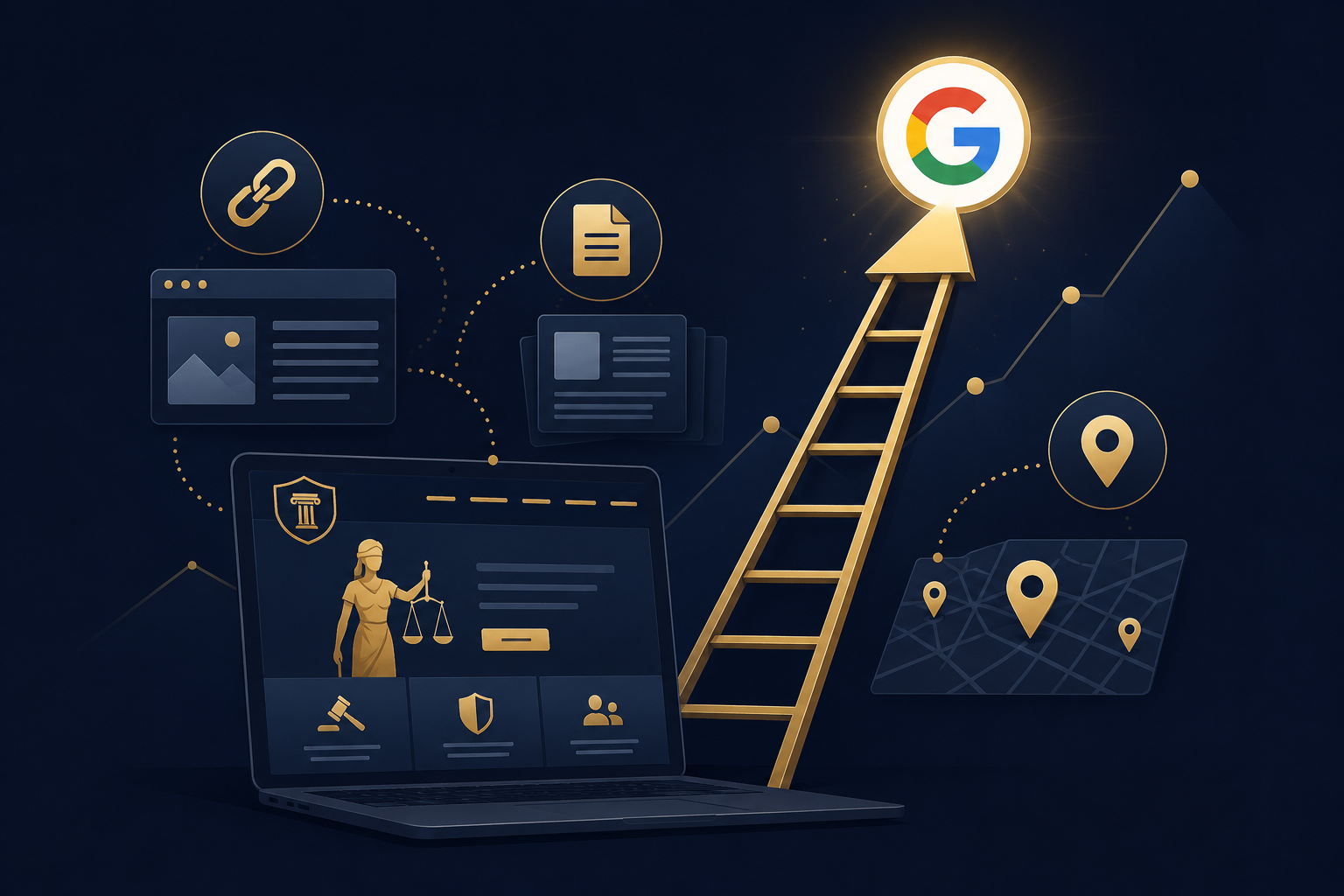
Getting PI law firm rankings moving requires all four of these working together. Firms that focus on one or two and ignore the others plateau quickly.
Technical SEO — the foundation everything else builds on
Before content or links can do their job, the site itself needs to be technically sound. For PI firms this means fast load times (Google’s Core Web Vitals are a confirmed ranking factor), mobile optimisation, clean site architecture, proper schema markup for law firms, and no crawl errors or duplicate content issues. A technically broken site will not rank well regardless of how strong the content or backlinks are.
Content — topical authority over keyword stuffing
The content approach that worked in 2015 — stuffing a practice area page with “car accident lawyer [city]” as many times as possible — actively hurts PI law firm rankings now. Google’s systems are sophisticated enough to evaluate whether content genuinely covers a topic with depth and accuracy, or whether it is thin content optimised around a keyword phrase.
For personal injury SEO, the content strategy that works is topical authority — building a cluster of genuinely useful content around the practice areas the firm handles, so Google recognises the site as a comprehensive and trustworthy resource on personal injury law. That means practice area pages, location pages, FAQ content, case type guides, and educational posts that answer the questions PI claimants actually search for.
Local SEO — Google Business Profile and citations
For most PI firms, the majority of their cases come from local searches. Ranking in the Google Map Pack for “[city] personal injury lawyer” is often worth more than a page one organic ranking because it appears above organic results and includes contact information directly in the search results. Optimising the Google Business Profile, building consistent NAP (name, address, phone) citations across legal directories, and generating genuine client reviews are all critical components of local personal injury SEO that many firms underinvest in.
Link building — the authority signal that separates page one from page two
This is where most PI firms either underinvest or invest badly. Backlinks remain one of Google’s strongest ranking signals, and in a competitive vertical like personal injury law, PI law firm rankings are largely determined by the quality and relevance of a firm’s backlink profile relative to competitors.
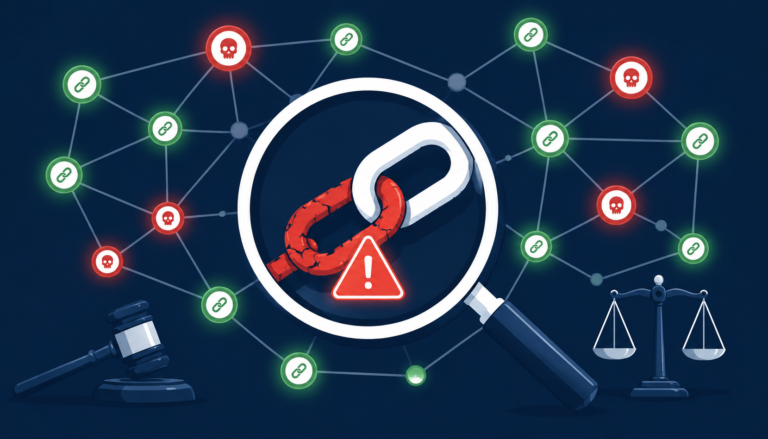
The mistake most firms make is treating link building as a volume game — buying cheap links from general directories or low-quality guest post sites to hit a number. In the PI niche, a handful of strong, topically relevant placements from genuine legal publishers outperforms dozens of irrelevant links every time.
What a Strong Legal Backlink Strategy Looks Like for PI Firms
A legal backlink strategy for a PI firm is not the same as a link building campaign for an e-commerce store or a SaaS company. The relevance signals matter more, the quality floor is higher, and the anchor text management requires more care because over-optimisation penalties hit harder in a niche Google already scrutinises closely.
Relevance over volume
Every placement in a PI firm’s backlink profile should come from a site that is genuinely relevant to legal, law, or personal injury content. A link from a legal news site, a law school resource, a court reporting publication, or a legal industry blog carries authority signal that a link from a general lifestyle site simply cannot match, regardless of domain rating.
DR tiers matched to campaign goals
Not every PI firm needs elite-level DR 50+ placements. A regional firm targeting mid-competition city terms may get more traction from a consistent flow of DR 25–40 placements from relevant legal sites than from one expensive high-DR placement on an unrelated domain. A strong legal backlink strategy matches placement quality to the specific competitive landscape the firm is operating in.
Anchor text variation
One of the most common over-optimisation mistakes in PI law firm SEO is building too many links with the same exact-match anchor text — “personal injury lawyer Chicago,” “car accident attorney,” and so on. Google’s Penguin algorithm is specifically designed to identify and penalise this pattern. A natural backlink profile uses branded anchors, partial match anchors, generic anchors, and URL anchors alongside the occasional exact match.
Consistency over bursts
A single link building campaign that delivers 30 links in one month and then nothing for six months sends a different signal than a consistent flow of 3–5 quality placements per month over a sustained period. PI law firm rankings respond better to the latter because it mirrors the natural link acquisition pattern of a genuinely authoritative site.
Where PI Firms Waste Their SEO Budget
Understanding what moves PI law firm rankings also means understanding what does not — and where firms consistently throw money without results.
Directory submissions at scale — submitting to 200 directories might have worked in 2010. Today it adds noise to your backlink profile without meaningful authority signal.
Thin content at volume — publishing 50 location pages with near-identical content, or buying cheap 300-word articles for link placements, does not build topical authority. Google’s helpful content systems are specifically designed to filter this out.
Chasing metrics over relevance — paying a premium for a DR 60 placement on a site that has nothing to do with law or legal content because the number looks impressive. Domain rating matters, but topical relevance matters more in a niche vertical.
One-off campaigns — treating SEO as a project with a start and end date rather than an ongoing investment. The PI firms that dominate local and national rankings have been building content and links consistently for years, not months.
How to Audit Your Current Personal Injury SEO Position
Before investing in any new SEO activity, it is worth understanding where the firm currently stands. A basic personal injury SEO audit covers:
Current rankings for primary practice area terms in target locations
Backlink profile quality — how many links, from what types of sites, with what anchor text distribution
Technical health — site speed, mobile performance, crawl errors
Content gaps — which practice area or location pages are missing or thin
Google Business Profile completeness and review volume versus competitors
This audit tells you which of the four pillars is the biggest drag on PI law firm rankings and where investment will have the most immediate impact.
The Role of a Specialist in Personal Injury SEO
Most general SEO agencies treat PI firms like any other local business client. They apply the same content templates, the same link building packages, and the same reporting dashboards they use for dentists, plumbers, and restaurants. The problem is that personal injury SEO has a higher quality floor, a more sophisticated competitive landscape, and more specific requirements around legal content accuracy and E-E-A-T signals than almost any other local niche.
Working with a specialist — whether that is a PI-focused SEO agency or a specialist legal link building broker for the backlink component — means the strategy is calibrated to the specific demands of the PI vertical rather than a generic local SEO playbook.
At LegallyRank, we focus exclusively on the link building component for PI firms and legal industry clients. Every placement in our inventory is vetted for legal niche relevance, DR, and editorial quality — built specifically to support a legal backlink strategy rather than add bulk to a profile.
Final Thoughts on Personal Injury SEO
PI law firm rankings do not move by accident. The firms on page one in competitive markets have invested consistently in all four pillars — technical SEO, topical content, local signals, and a disciplined legal backlink strategy. The good news is that most PI firms are not doing all four well, which means there is genuine opportunity for firms willing to approach SEO systematically rather than chasing shortcuts.
If the backlink component is where your personal injury SEO strategy has the weakest foundation, that is often the fastest lever to pull — because it is the one most directly correlated with authority in Google’s ranking systems.