Anchor Text Strategy for Medical Malpractice Law Firms
A recognized legal marketing publication’s own medical malpractice SEO guidance says something worth pausing on: when linking to your own article, hyperlink using the exact phrase that article is about. That’s genuinely correct advice — for internal links specifically. Applied to external backlinks, the same tactic is one of the fastest ways to trigger a manual action. Most anchor text guidance treats internal and external linking as though the same rules apply to both, and that conflation is exactly where firms get into trouble.
This guide covers what anchor text strategy should actually look like for a medical malpractice firm — the meaningful difference between internal and external rules, how case-type content structure should shape anchor variation, and the specific ratio worth targeting for external placements in this niche.
Why Internal and External Anchor Text Follow Genuinely Different Rules
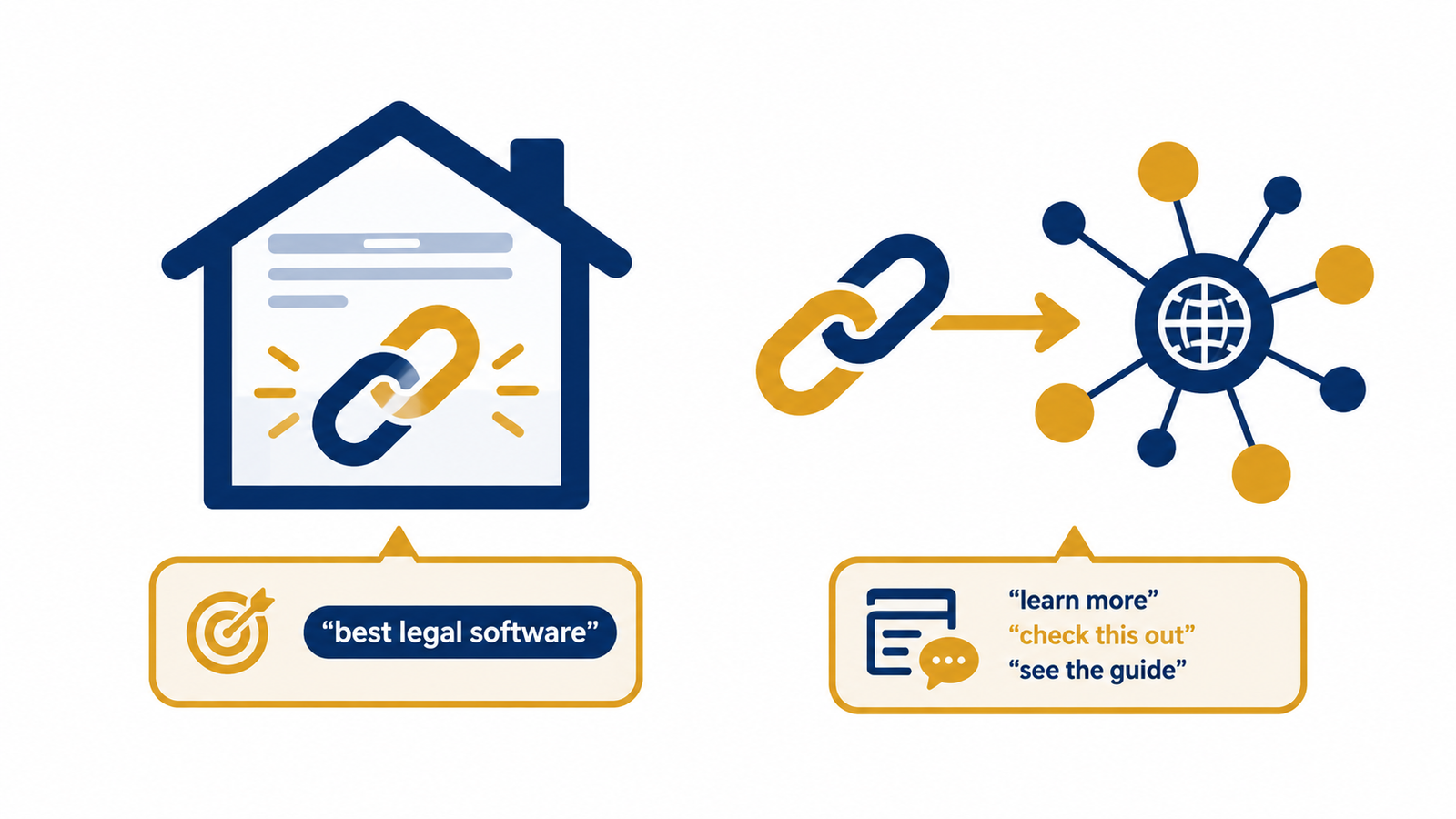
This is the single most important distinction this guide covers, and it’s the one most general anchor text advice glosses over. For internal links — links between pages on your own site — using descriptive, keyword-rich anchor text is not just safe, it’s actively recommended. Google has confirmed there’s no over-optimization penalty for internal linking the way there is for earned backlinks, meaning a medical malpractice firm can and should link internally using the exact phrase a linked page is actually about.
This is exactly the guidance a med mal-focused legal marketing publication gives directly: when linking to an article about a specific topic, hyperlink using that topic’s actual phrase. Applied to case-type content specifically, this means an article discussing birth injury claims broadly can and should link internally to a dedicated birth injury page using anchor text like “birth injury claims” or “cerebral palsy malpractice cases” — descriptive, specific, and safe.
External backlinks operate under the opposite logic. A backlink profile heavy on exact-match commercial anchors — the same target keyword repeated across many external links — is precisely the pattern link-spam detection systems are built to catch, and multiple current sources are consistent and direct on this point: search engines have become sophisticated enough to recognize when exact-match anchors are being used to manipulate rankings rather than occurring naturally.
What a Safe External Anchor Ratio Looks Like for Medical Malpractice
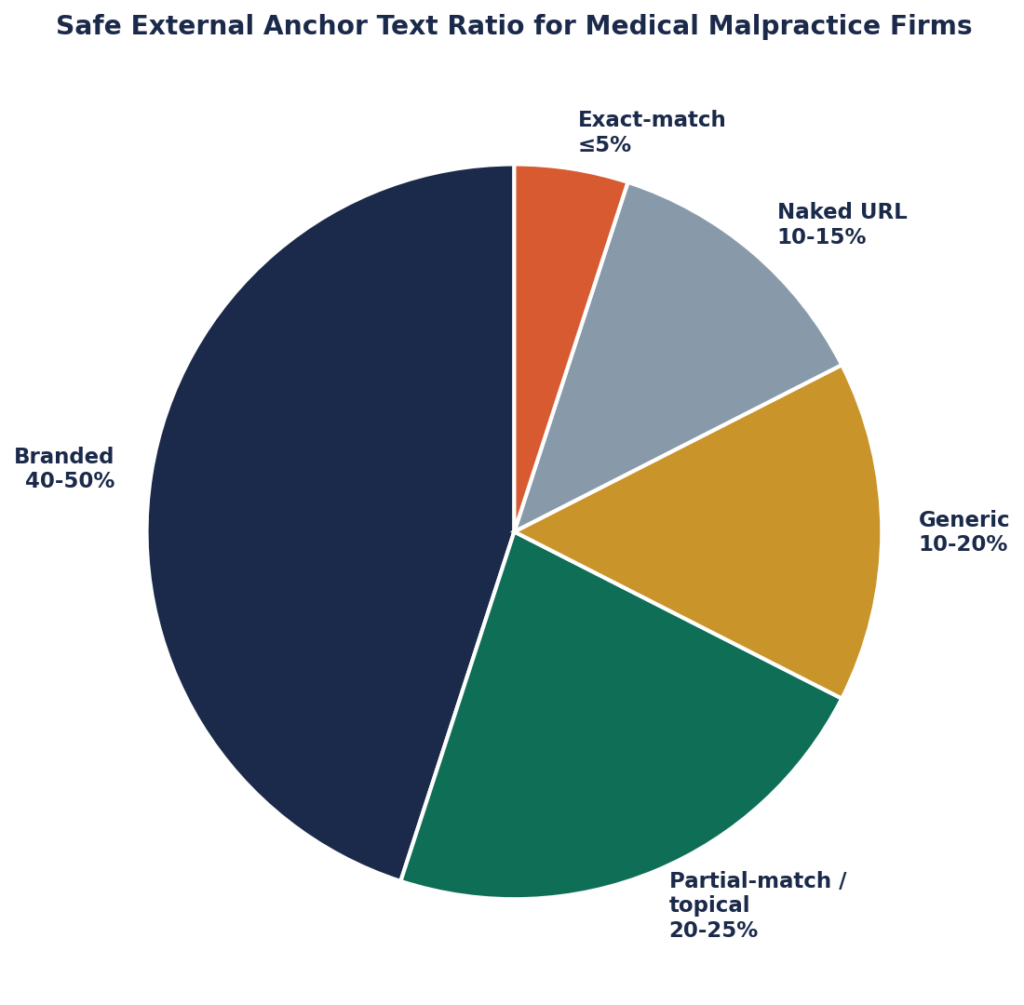
Applying the general anchor text distribution principles relevant to legal link building broadly, with adjustments for medical malpractice’s elevated YMYL scrutiny, a reasonable target for external backlink anchor text looks like this: branded anchors (your firm’s name) making up the largest share, roughly 40-50 percent; partial-match or topical anchors — phrases related to but not identical to your target keyword — at 20-25 percent; generic anchors (“this resource,” “learn more”) at 10-20 percent; naked URLs at 10-15 percent; and exact-match commercial anchors kept to 5 percent or less.
Given medical malpractice’s even more intense YMYL scrutiny compared to general personal injury, there’s a reasonable case for erring toward the more conservative end of this range — treating 5 percent exact-match as a ceiling, not a target to reach, particularly in a firm’s first 20-30 external backlinks while the domain is still establishing its overall trust profile.
How Case-Type Content Structure Should Drive Anchor Variation
This is where medical malpractice’s specific content architecture genuinely changes the anchor text conversation compared to a firm with a single, generic practice area page. Given the case-type-specific content structure worth building for this practice area — separate, deep pages for surgical errors, birth injuries, misdiagnosis, medication errors, anesthesia mistakes — anchor text variation should mirror that same specificity rather than collapsing everything into a single broad “medical malpractice lawyer” anchor repeated across every link.
A useful parallel: a firm covering diabetes-related medical content might vary anchor text across related but distinct phrases — “diabetes diagnosis errors,” “diabetes medication mistakes,” “diabetes care negligence” — rather than repeating “diabetes malpractice” identically every time. Applied to a medical malpractice firm’s case-type architecture, this means anchor text pointing toward a surgical error page might vary naturally across “surgical error attorney,” “wrong-site surgery claims,” and “post-surgical negligence cases” depending on context, rather than using one fixed phrase across every reference.
This natural variation serves two purposes simultaneously: it avoids the exact-match over-optimization risk covered above, and it reinforces topical breadth across a genuinely wider set of related terms than a single repeated anchor phrase ever could — directly supporting the broader semantic cluster strategy relevant to how this niche’s actual keyword landscape is structured.
What This Looks Like in Practice for External Guest Post Placements
When negotiating anchor text for an external guest post or editorial placement, the practical application of everything above looks like this: propose branded or naturally-phrased anchors as the default, let a natural, topically-relevant phrase emerge from the surrounding content context rather than forcing a specific exact-match term, and treat any exact-match request from a provider or brokerage as a flag worth questioning rather than a standard, expected practice.
This connects directly to evaluating a link building provider or brokerage’s own practices — a provider pushing hard for exact-match anchors across every placement, rather than defaulting to natural, varied phrasing, is applying an outdated or genuinely risky approach regardless of how confidently it’s presented, given how directly current guidance across multiple independent sources converges on natural variation as the safer, more effective standard.
A Worked Example: Applying Both Rule Sets to a Single Piece of Content
Consider a firm publishing a new blog post specifically about surgical error claims. Within that post, internal links to related content should use specific, descriptive anchors: a reference to the firm’s broader medical malpractice overview page might use “medical malpractice claims process” as anchor text, while a reference to a related case-type page might use “wrong-site surgery lawsuits” — both exact, descriptive phrases tied directly to what each linked page covers, following the internal-linking guidance above without hesitation.
Now consider that same post being pitched as a guest contribution to an external medical-adjacent publication, with a link back to the firm’s own surgical error page included as part of the placement. Here, the anchor text approach shifts: rather than repeating “surgical error attorney” verbatim as the anchor, a more natural phrasing might read something like “attorneys handling wrong-site surgery cases” embedded naturally within a sentence, or simply the firm’s branded name if that fits the surrounding context better. The same target page, the same firm, but two genuinely different anchor text approaches depending on whether the link is internal or external — exactly the distinction most generic anchor text guidance collapses into a single, oversimplified rule.
Common Mistakes Firms Make Applying Anchor Text Guidance Incorrectly
Reading general “anchor text should match content” advice and applying it uniformly to both internal and external links. This is precisely the conflation this guide is built to prevent — advice that’s genuinely correct for internal linking becomes genuinely risky when applied without modification to external backlinks.
Assuming a case-type content strategy alone automatically produces natural anchor variation. Having a dozen distinct case-type pages doesn’t automatically mean external anchor text pointing at them varies naturally — a firm still needs to deliberately vary phrasing across placements pointing at the same page over time, rather than defaulting to the same exact case-type phrase repeatedly just because multiple genuinely different pages exist to link to.
Letting a guest post provider default to whatever anchor text is administratively easiest for them, rather than reviewing what’s actually being used. Providers managing placement volume sometimes default to a firm’s most obvious target keyword repeatedly across multiple placements simply because it’s the fastest default, without actively tracking whether this is producing an over-concentrated exact-match pattern across the firm’s overall profile.
Treating anchor text ratio as a one-time setup decision rather than something to monitor as a profile grows. A ratio that looks healthy at 15 total backlinks can drift out of balance by 50, particularly if several placements land in a short window using similar phrasing — periodic review, not a single initial calculation, keeps this genuinely balanced over time.
Why This Matters More Given Medical Malpractice’s Competitive Content Landscape
Firms in this space are competing for content and citation attention in a genuinely dense field — dedicated agencies serving specifically medical malpractice and healthcare defense firms have built entire service lines around guest post and digital PR placements for exactly this niche, reflecting how much genuine competitive activity already exists here. In a competitive landscape this dense, a backlink profile with unnatural, repetitive anchor patterns stands out more conspicuously than it might in a less contested niche, making the natural-variation principle covered throughout this guide not just a compliance safeguard but a genuine differentiator against competitors who may be applying more aggressive, riskier anchor strategies.
Tracking Anchor Text Distribution as a Profile Grows
Given how easily this ratio can drift, a practical tracking approach is worth building into a firm’s ongoing link building process rather than treating it as a one-time calculation. A simple spreadsheet logging every external backlink, its anchor text, and which category it falls into (branded, partial-match, generic, naked URL, exact-match) provides enough visibility to calculate the current ratio at any point without requiring a paid tool subscription specifically for this purpose, though most standard SEO tools also offer some version of anchor text distribution reporting built in.
Reviewing this quarterly, alongside the broader backlink audits already worth conducting for toxic link monitoring, keeps anchor text drift from compounding unnoticed. A firm discovering its exact-match percentage has crept above the 5 percent ceiling covered earlier has a straightforward corrective path: weight new placements deliberately toward branded and generic anchors until the overall ratio rebalances, rather than needing to take any action on existing links themselves.
How This Connects to Working With an Outside Link Building Provider
Given everything covered throughout this guide, anchor text practice is a genuinely useful diagnostic question to ask any prospective link building provider or brokerage before engaging them. A provider that can clearly articulate the internal-versus-external distinction, describe a target ratio broadly consistent with the benchmarks above, and explain how they vary anchor phrasing across case-type-specific placements is demonstrating real, current expertise. A provider that either doesn’t distinguish between the two contexts at all, or defaults to exact-match anchors as a standard practice without flagging the risk, is applying an approach that current, independent guidance across multiple sources has moved well past.
Why This Guidance Will Likely Keep Evolving
It’s worth closing with an honest note about how anchor text guidance itself has changed over time and will likely continue to. Search engines’ ability to detect manipulative anchor patterns has grown consistently more sophisticated over the past several algorithm generations, meaning practices that were considered acceptable several years ago — heavier exact-match usage, less deliberate variation — have grown progressively riskier even without any single dramatic policy announcement marking the shift.
This means the specific ratio benchmarks covered in this guide should be understood as current, reasonable guidance reflecting today’s landscape, not a permanently fixed rule. A firm building a long-term link building practice benefits from staying generally aware of how this guidance evolves, rather than treating a specific ratio memorized once as permanently correct regardless of how search systems’ sophistication continues to develop.
Frequently Asked Questions
Should internal anchor text always use the exact target keyword for the linked page?
Yes, this is both safe and recommended — Google has confirmed no over-optimization penalty applies to internal linking, and using descriptive, specific anchor text for internal links to case-type pages genuinely helps both search engines and readers understand what each page covers.
What percentage of a firm’s external backlinks should use exact-match commercial anchor text?
Five percent or less is the reasonable ceiling for medical malpractice specifically, given this niche’s elevated YMYL scrutiny — treat this as a maximum to stay under, not a target volume to actively pursue, particularly for a newer domain still building its overall trust profile.
Does anchor text variation across case-type content genuinely help rankings, or is it purely a risk-avoidance tactic?
It does genuinely help, beyond just avoiding over-optimization risk — natural anchor variation across related but distinct phrases reinforces topical breadth across a wider semantic cluster than a single repeated exact-match anchor could, which connects directly to how search engines evaluate genuine topical authority across a site’s full content range.
Who should control anchor text decisions when working with a guest post provider or brokerage — the firm or the provider?
The firm should retain meaningful input rather than deferring entirely to a provider’s default anchor choices, since a provider defaulting to aggressive exact-match anchors across every placement is applying an outdated or risky approach regardless of how the placement is otherwise positioned.
How does anchor text strategy differ between a guest post the firm writes itself versus a genuine editorial mention or digital PR placement?
A firm has direct control over anchor text in a self-written guest post, making the guidance in this article directly actionable during content drafting. A genuine editorial mention offers little to no anchor control, since the linking decision belongs to the publication’s editor — this is one of the real tradeoffs between guest posting and earned editorial coverage covered elsewhere in this cluster.
Is it risky to use the same anchor text twice across two different external placements, or does every single link need a unique phrase?
Occasional repetition isn’t inherently risky — the concern is a pattern, not any single instance. A backlink profile with, for example, five links using the firm’s branded name as anchor text isn’t a red flag; the risk specifically concentrates around repeated exact-match commercial phrases used consistently across many external links.
Should a firm audit its existing backlink profile’s anchor text distribution even if it hasn’t been actively pursuing an aggressive link building campaign?
Yes, periodically — even a firm that hasn’t run an aggressive campaign may have accumulated an unbalanced anchor profile over time through inconsistent guest posting or a previous provider’s less careful practices, and a periodic audit against the ratio benchmarks in this guide catches drift before it becomes a genuine risk pattern.
Does the case-type content architecture relevant to this practice area make anchor text strategy more complex than it would be for a firm with a single generic practice area page?
Somewhat more involved in terms of tracking, yes, since there are genuinely more distinct target pages and topic phrases to vary anchor text across — but this complexity is a net benefit rather than a burden, since it naturally supports the broader anchor variation this guide recommends rather than creating pressure to repeat a single phrase across every placement the way a single-page practice area structure might.
If a firm inherited a backlink profile with a concentrated pattern of exact-match anchors from a previous, less careful provider, is there anything that can be done beyond simply building new links more carefully going forward?
Building new placements with deliberately varied, branded-heavy anchor text going forward is the primary corrective path, since this gradually dilutes the existing pattern’s overall share of the profile. In more severe cases — particularly if a manual action has already been received specifically citing unnatural anchor text patterns — the disavow process covered elsewhere in this cluster becomes a more direct, if more drastic, option worth considering alongside the dilution approach.
The Bottom Line
Anchor text strategy for medical malpractice firms requires holding two genuinely different rule sets simultaneously: internal links can and should use exact, descriptive phrasing tied to each case-type page’s specific topic, while external backlinks need natural variation weighted heavily toward branded and topical anchors, with exact-match commercial phrases kept to a firm ceiling given this niche’s elevated scrutiny. Firms and providers that conflate these two rule sets — either over-optimizing internal links out of unnecessary caution, or applying aggressive exact-match anchors to external placements the way internal-linking advice might suggest — are working from an incomplete picture of how anchor text actually functions across these two genuinely different contexts.