DR vs DA vs Authority Score: Which Metric Should Med Mal Firms Trust?
Three tools, three different scores, and none of them a direct Google ranking factor — that’s the honest starting point for understanding Domain Rating, Domain Authority, and Authority Score. For a medical malpractice firm evaluating link building opportunities, the confusion these three metrics create isn’t just academic; it directly affects which placements get pursued and which get passed over, often based on numbers that measure genuinely different things and rarely agree with each other for the same site.
This breaks down what each metric actually measures, why they disagree, and — more importantly for medical malpractice specifically — why link source and relevance matter more here than any of these three scores in isolation.
What Each Metric Actually Measures
Domain Rating (Ahrefs) is deliberately narrow: a pure link-graph score based on unique referring domains, the strength of those domains, and how many other sites each one links out to. Ahrefs is explicit that DR leaves out organic traffic, spam signals, and domain age entirely — it measures link authority and nothing else.
Domain Authority (Moz) takes a broader approach, calculated through a machine learning model incorporating over 40 signals related to link quality and quantity, designed to predict how likely a domain is to rank well in search results generally, not just to score its raw link profile.
Authority Score (Semrush) is the most holistic of the three, explicitly blending link power, organic traffic data, and spam signal detection into a single composite score. This makes it the only one of the three tools genuinely designed to help distinguish links that are actually helping a site from links that might be hurting it — a meaningfully different purpose than DR or DA.
Why These Scores Rarely Match for the Same Site
Because each company builds its own link index using its own web crawler and its own proprietary formula, the same website will typically show different scores across all three tools, sometimes by a significant margin. This isn’t a bug or inconsistency worth troubleshooting — it’s simply a product of three separate companies measuring related but genuinely different things using different underlying data.
This matters practically because comparing a DR score from one prospective link building site against a DA score from another isn’t a valid comparison at all — it’s comparing two different measurement systems as though they were interchangeable. Any evaluation should use a single tool consistently across all sites being compared, rather than mixing scores pulled from different sources.
None of These Are Google Ranking Factors — Confirmed Directly, Repeatedly
This is worth stating plainly since it’s easy to lose sight of given how central these metrics are to link building conversations: Google has repeatedly and directly confirmed, including statements from Google’s own John Mueller, that neither Domain Authority, Domain Rating, nor Authority Score are direct inputs into Google’s actual ranking algorithm. These are third-party proxy metrics, useful for competitive benchmarking and prospecting, not literal ranking signals Google itself uses.
This matters for how a firm should actually use these scores: as a rough, directional comparison tool for evaluating relative site strength during prospecting, not as a target to optimize toward directly, and never as a substitute for the genuine relevance and traffic signals that matter more for actual ranking impact.
Why the .edu and .gov Link Premium Matters More in Medical Malpractice Than Almost Anywhere Else
This is the single most important medical-specific point in this comparison: a genuine link from a university medical center (.edu) or a government health authority (.gov) carries meaningfully more real ranking weight in healthcare and medical-legal content specifically than hundreds of links from generic lifestyle or general business sites, regardless of what any of the three authority scores would suggest about those hundreds of lower-tier links in aggregate.
This isn’t just a general “quality over quantity” restatement — it’s a specific, outsized premium tied directly to the elevated trust these institutional source types carry for YMYL health content specifically. A single genuine citation or link from a university hospital’s patient resources page, or a state or federal health agency’s published guidance, functions as exactly the kind of institutional third-party validation the E-E-A-T evaluation this niche depends on most heavily rewards — value that no volume of generic guest post placements, however favorable their DR or DA scores look, can genuinely replicate.
What This Means for How Medical Malpractice Firms Should Use These Metrics
Given the above, a medical malpractice firm evaluating a prospective link opportunity should treat any of the three authority scores as a starting filter, not the deciding factor. A DR 35 placement on a genuinely relevant patient advocacy site with real traffic and, ideally, some institutional or medical citation connections, is likely worth more than a DR 55 placement on a generic, unrelated business blog — even though the raw score comparison would suggest the opposite.
This connects directly to the tiered relevance framework worth applying to any guest post vetting decision: source type and genuine topical relevance should weigh more heavily than the raw authority number in isolation, and this is especially true for medical malpractice given how disproportionately valuable genuinely institutional health sources are compared to generic sites with superficially similar or even higher authority scores.
Realistic Authority Benchmarks for Medical-Legal Content
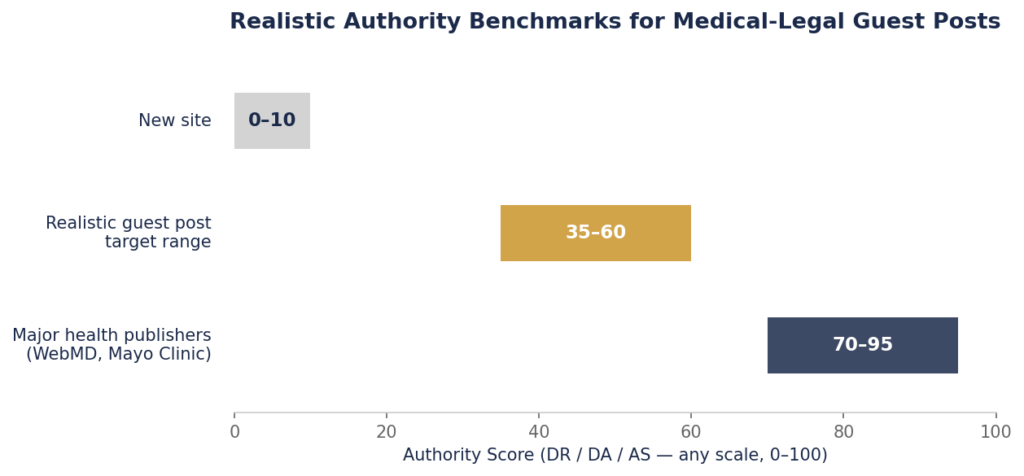
Understanding what a “good” score actually looks like in context helps calibrate expectations. New sites typically start near the bottom of any of these scales. Major established health publishers — sites like WebMD or Mayo Clinic — sit in the 70 to 90-plus range on most of these metrics, representing the extreme high end most individual firms and even most individual guest post targets won’t reach or need to reach.
For a realistic medical-legal guest post prospect, a meaningfully solid target range sits in the 35 to 60 range on most of these scales, provided it’s paired with genuine traffic and the medical-specific vetting standards covered elsewhere in this cluster — named credentialed authorship, primary-source citation, documented editorial policy. A site scoring in this middle range with those qualitative factors in place is a stronger, more defensible placement than a higher-scoring site lacking them.
The more useful benchmark than any absolute number, though, is relative: checking the authority scores of sites that are actually ranking for a firm’s target keywords provides a genuinely relevant comparison point, rather than treating any of these scales’ numbers as meaningful in isolation from real competitive context.
The Growing Connection Between Genuine Authority and AI Citation
Beyond traditional ranking considerations, recent research adds a new dimension worth understanding: a large majority of citations in AI-generated search summaries trace back to earned media coverage in genuine publications, not brand-owned or paid content. Critically, this research suggests the underlying signal that drives a legitimate DR or DA score — genuine editorial backlinks from real publications — is largely the same signal that correlates with AI citation likelihood. A site with strong authority built through genuine digital PR and earned editorial coverage tends to get cited by AI systems; a site with an inflated authority score built through low-quality, purchased link volume generally does not.
This reinforces, from a different angle, the same point made throughout this cluster: the specific number a tool assigns matters less than the genuine quality and legitimacy of what’s actually behind that number. Two sites with an identical DR score can carry meaningfully different real value depending on whether that score reflects genuine earned authority or inflated, purchased link volume — and increasingly, this distinction matters not just for traditional rankings but for whether AI systems trust a site enough to cite it.
A Worked Comparison: Two Prospects Side by Side
Making this concrete helps more than the abstract principle alone. Consider two guest post prospects a medical malpractice firm might be evaluating in the same week.
Prospect A is a general legal marketing blog showing DR 58 in Ahrefs, decent traffic, and a broad mix of content spanning family law, criminal defense, business law, and occasional personal injury coverage. Prospect B is a patient safety advocacy organization’s blog showing DR 41, more modest traffic, but with several existing citations to CDC data, a documented editorial review process, and occasional backlinks from university hospital patient resource pages elsewhere in its own link profile.
On a pure score comparison, Prospect A looks stronger — a meaningfully higher DR with more raw traffic. But applying the framework throughout this guide, Prospect B is very likely the better placement for medical malpractice content specifically: its existing link profile already demonstrates the kind of institutional trust connections this niche’s E-E-A-T evaluation rewards, its editorial standards align with the medical-specific vetting checks this content category requires, and its topical relevance to legal-medical intersection content is significantly stronger than Prospect A’s broad, unfocused legal coverage. The raw DR gap doesn’t override this — it’s exactly the kind of case where the score alone would lead to the weaker decision.
Why Firms Get This Wrong: The Psychology of a Single Number
It’s worth understanding why the pull toward prioritizing the higher raw score is so strong despite everything covered above. A single number is easy to compare, easy to report to stakeholders, and easy to use as a simple pass/fail filter when evaluating dozens of prospective placements under time pressure. The more nuanced evaluation this guide describes — checking institutional connections, topical relevance, and medical-specific editorial standards — takes genuinely more time and judgment than glancing at a DR score.
This is precisely why firms and even some link building providers default to score-based prospecting as a primary filter rather than a rough first pass. The practical fix isn’t abandoning these metrics entirely — they remain useful for quickly narrowing a large prospect list down to a manageable set worth deeper review — but using them as a first filter rather than the final decision, with the genuine relevance and institutional-source evaluation covered throughout this guide applied to whatever makes it through that initial screen.
How This Connects to Evaluating a Provider’s Reported Results
This same metric confusion extends to how firms should interpret a link building provider’s reported success metrics. A provider reporting “average DR 55 placements” is providing a genuinely useful data point, but it’s incomplete without also knowing what share of those placements came from genuinely relevant, institutionally-connected sources versus generic higher-scoring sites chosen primarily because they were easy to place on affordably. Asking a provider directly what percentage of placements include genuine medical or legal-medical topical relevance, separate from the aggregate authority score they report, produces a much more useful evaluation than the score alone.
A Practical Checklist for Using These Metrics in Prospecting
Pick one tool and use it consistently across every site being compared, rather than mixing scores from different sources. Treat the score as a rough filter, not a final decision — a site passing the authority threshold still needs the genuine traffic, relevance, and medical-specific vetting checks covered elsewhere in this cluster before it’s a defensible placement. Weight institutional source types — .edu, .gov, established medical and legal publications — more heavily than the raw score alone would suggest, given the outsized trust premium these carry specifically in medical-legal content. And benchmark against what’s actually ranking for target keywords, rather than treating any absolute score threshold as universally meaningful across every market and competitive context.
Why This Matters More as AI Search Continues to Grow
The connection between genuine authority and AI citation likelihood covered above is worth returning to as a closing point, since it reframes why getting this metric confusion right matters more now than it did even a couple of years ago. A firm that optimizes purely for the highest available DR or DA number, without regard for whether that authority reflects genuine earned coverage or inflated link volume, may see a number that looks impressive on a report while gaining little of the actual downstream benefit — neither the traditional ranking value genuine authority provides, nor the AI citation likelihood that increasingly depends on the same underlying signal of real, earned editorial trust.
This is ultimately the same principle that runs throughout this entire cluster in different forms: genuine quality and relevance consistently outperform metrics gamed in isolation, and medical malpractice’s elevated scrutiny simply makes the gap between the two outcomes more consequential than it would be in a lower-stakes practice area.
Frequently Asked Questions
Which of the three metrics should a medical malpractice firm rely on primarily?
There’s no universally correct choice — each measures something genuinely useful, and Authority Score’s inclusion of traffic and spam signals makes it particularly relevant for auditing existing link quality, while DR’s narrower link-graph focus makes it useful for quick prospecting comparisons. The more important principle is picking one and using it consistently, rather than which specific one is chosen.
Is it ever worth pursuing a placement on a site with a lower authority score if it’s a genuinely relevant, institutional source?
Yes, often emphatically so. A lower-scoring .edu or .gov-adjacent health resource, or a genuinely relevant patient advocacy organization, frequently carries more real value for a medical malpractice firm’s E-E-A-T signals than a higher-scoring but generic, unrelated site, given the institutional trust premium covered throughout this guide.
How often do these authority scores update, and does that affect prospecting decisions?
Update frequency varies by tool, generally ranging from weekly to monthly depending on the provider’s crawling schedule. This means a score checked during initial prospecting may shift somewhat by the time a placement actually goes live, which is a reasonable argument for treating the score as directional rather than precise, consistent with the broader guidance throughout this guide.
Should a firm be suspicious of a site with an unusually high authority score relative to its apparent size or traffic?
Yes — this mismatch is one of the clearest indicators worth investigating further, since it often signals a manipulated link profile rather than genuine authority, connecting directly to the toxic backlink vetting considerations relevant to any prospective placement, particularly given how directly Authority Score specifically is designed to help flag this kind of pattern.
Does the .edu and .gov premium apply to any link from an educational or government domain, or only genuinely health-relevant ones?
The premium specifically applies to genuinely relevant institutional sources — a university medical center’s patient resources, a state or federal health agency’s guidance — not simply any .edu or .gov domain regardless of topical connection. A link from an unrelated academic department or an irrelevant government agency page carries a domain-type signal but lacks the genuine topical relevance that makes the premium meaningful in the medical malpractice context specifically.
How does this authority metric confusion affect how a firm should evaluate a link building provider’s reported results?
Ask specifically which tool and metric a provider is reporting results against, since a provider showing DR improvements isn’t directly comparable to another showing DA or Authority Score improvements. More importantly, ask whether reported authority gains are accompanied by genuine traffic and relevance improvements, not just a rising number on one specific tool’s scale, given how disconnected an inflated score can be from genuine value as covered throughout this guide.
Is it worth paying for access to all three tools rather than picking just one?
For most individual firms managing their own link building, one primary tool used consistently is sufficient, and the cost of maintaining subscriptions to all three rarely justifies the marginal benefit over simply understanding, as this guide covers, that any single tool’s score is directional rather than precise. Agencies and specialist brokerages managing link building across many clients more often justify multi-tool access, since cross-referencing becomes more valuable at that scale of prospecting volume.
Can a firm improve its own site’s authority score meaningfully through means other than backlinks?
Not significantly — all three metrics are fundamentally link-graph based, even Authority Score despite incorporating traffic and spam signals alongside link data. Genuine improvement requires earning links from authoritative, relevant sources over time; there’s no meaningful shortcut through on-page optimization or content alone, though strong content is what ultimately earns the links that do move these scores.
The Bottom Line
Domain Rating, Domain Authority, and Authority Score each measure something genuinely useful, but none of them are Google ranking factors, none of them agree with each other for the same site, and none of them capture the single most important nuance for medical malpractice specifically: a genuine link from a university medical center or government health authority frequently outweighs hundreds of links from generic sites, regardless of what any of these three scores would suggest in isolation. Use whichever metric your primary tool provides as a rough prospecting filter, but let genuine institutional relevance and the medical-specific vetting standards covered elsewhere in this cluster drive the actual placement decision.