
How Much Does Medical-Legal Guest Posting Cost in 2026?
Ask three different sources what a guest post costs and you’ll get three different numbers — anywhere from $164 to $459 as an industry average, depending entirely on which dataset and which mix of niches gets analyzed. For medical-legal content specifically, none of these broad averages tell the real story, because medical malpractice sits at the intersection of two premium-priced categories simultaneously: legal content and health content, each carrying its own YMYL pricing premium independently.
This breaks down what medical-legal guest posting actually costs in 2026, why it commands a real premium over general legal or general health content separately, and how to evaluate whether a specific quote reflects genuine market pricing or something worth questioning.
Why Medical-Legal Content Costs More Than Either Category Alone
Healthcare-focused link building currently averages $350 to $900 per link, with medical device, pharmaceutical, and clinical service content often exceeding $1,000 for genuinely authoritative placements. This sits meaningfully above general guest post pricing, which averages somewhere in the $164 to $459 range depending on the dataset, reflecting how directly YMYL scrutiny drives cost in health-adjacent categories specifically.
Legal content carries its own premium for similar reasons — competitive commercial value and stricter editorial standards relative to lower-stakes niches. Industry pricing analysis consistently shows finance, legal, and health niches commanding a 30 to 40 percent premium over general content pricing, driven by higher competition for placements and the genuine additional value these links carry when done well.

Medical malpractice content sits at the overlap of both premiums simultaneously. A publication willing to accept genuinely legal-medical content — content that makes both legal claims about standards of care and factual claims about medical procedures or outcomes — is applying editorial scrutiny from both directions at once, which is reflected in pricing that typically sits above either category’s premium taken alone.
What Drives the Specific Number for a Given Placement
Domain authority remains a primary driver, with pricing analysis showing each additional 10 points of domain rating increasing typical backlink pricing by roughly 32 percent. This relationship holds in medical-legal content too, though the absolute dollar figures at each authority tier run higher than general content given the YMYL premium layered on top.
Genuine organic traffic adds a separate premium beyond authority alone. Sites with meaningfully higher real traffic command pricing $50 to $350 above otherwise comparable lower-traffic sites at the same authority level, reflecting the real audience reach a higher-traffic placement delivers beyond its raw authority score.
Expert authorship requirements add a distinct, quantifiable cost layer specific to YMYL content. Having content reviewed or bylined by a credentialed professional — in this case, a licensed medical professional, an attorney, or ideally both for genuinely legal-medical content — typically adds $100 to $500 per piece on top of base placement pricing, reflecting the real additional labor and liability consideration involved in credentialed review.
Content format and depth requirements affect total cost independently of placement fees. Standard guest post content in the 1,000 to 1,500 word range typically costs $150 to $300 for quality writing alone, while longer-form content with original research, data, or expert interviews can run $500 to $1,000 or more before any placement fee is added. Given how directly content depth ties to E-E-A-T signals in medical-legal content specifically, this is rarely an area worth cutting corners to save cost.
Realistic Pricing Tiers for Medical-Legal Guest Posting
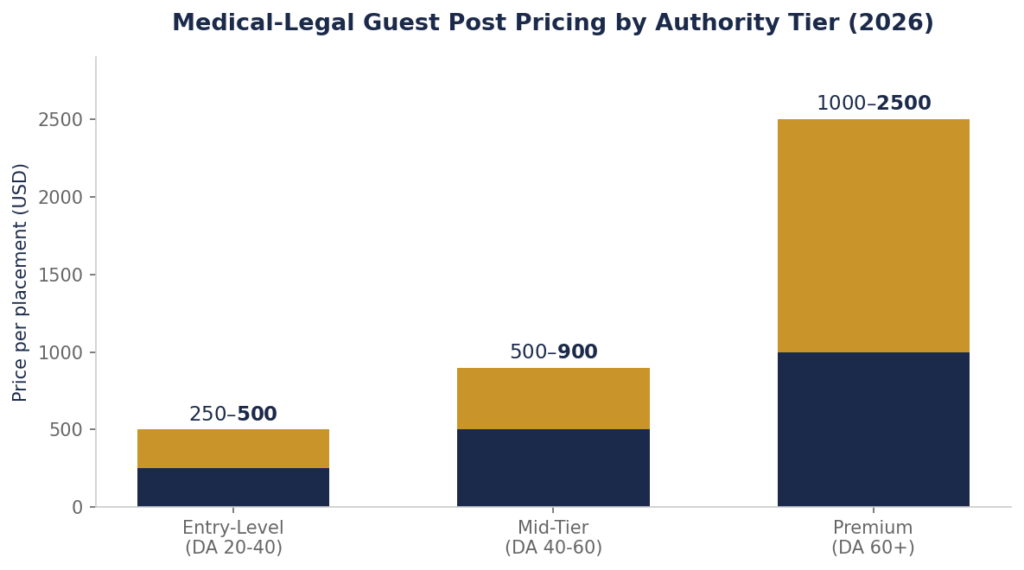
Entry-level, lower-authority placements (DA 20-40): roughly $250 to $500 total, including modest content requirements. These placements can have a role in a broader diversified backlink profile, but shouldn’t carry primary weight in a medical malpractice link building strategy given the elevated trust requirements this niche demands.
Mid-tier, genuinely credible placements (DA 40-60): roughly $500 to $900 total once expert authorship and adequate content depth requirements are factored in. This tier represents the realistic core of a solid medical-legal link building program for most firms — meaningful authority combined with achievable, sustainable pricing.
Premium editorial placements (DA 60+, genuinely authoritative health or legal-medical publications): $1,000 to potentially several thousand dollars for the most authoritative, selective publications in this space. Given case values in medical malpractice, this tier is often genuinely worth pursuing selectively even at premium pricing, though it shouldn’t represent the bulk of placement volume for most firms given the cost.
Curated Links and Niche Edits as a Lower-Cost Alternative Worth Understanding
Beyond traditional guest posting, curated links — also called niche edits, where a link gets inserted into existing, already-published content rather than requiring a new article — represent a meaningfully cheaper alternative worth understanding, typically running 50 to 55 percent below equivalent guest post pricing at the same authority tier.
This cost difference exists because a niche edit avoids new content production costs and often benefits from being placed into already-indexed, already-ranking content rather than starting from zero. For medical-legal content specifically, this option requires real caution — a niche edit inserted into existing content needs to fit naturally and shouldn’t require the host site to make claims it wouldn’t otherwise stand behind, and the same medical-specific vetting checks relevant to any placement still apply regardless of format. Used thoughtfully, though, this represents a genuine cost-efficient complement to full guest post placements rather than a lesser-quality substitute.
Why Cheap Medical-Legal Placements Deserve Even More Scrutiny Than Cheap General Content
The cheap-versus-quality link tradeoff relevant to link building generally applies with less room for compromise in medical-legal content specifically. A placement priced dramatically below the benchmarks above — a $50 or $75 “medical guest post” — almost certainly isn’t meeting the credentialed authorship, citation quality, and editorial standards this niche’s YMYL scrutiny genuinely requires, regardless of how it’s marketed.
This matters more here than in general content categories because a backlink profile that includes placements failing basic medical-content quality standards doesn’t just underperform — it can actively work against the E-E-A-T signals a medical malpractice firm’s own site depends on, given how closely search engines evaluate a site’s backlink neighborhood in YMYL-sensitive categories. The cost of a wasted or counterproductive cheap placement is proportionally larger here than the same mistake would be in a lower-stakes content category.
How to Evaluate Whether a Specific Quote Is Reasonable
Given how wide the range of legitimate pricing can be depending on authority, traffic, and content requirements, a useful evaluation approach is checking whether a specific quote’s components add up logically rather than judging the total figure in isolation. A $700 quote for a DA 55 site with genuine traffic, credentialed authorship, and 1,500 words of well-researched content is a coherent, defensible number given the benchmarks above. The same $700 quote for a DA 25 site with minimal traffic and no stated credentialing requirement is a mismatch worth questioning directly.
Ask specifically what the quote includes — does it cover content writing or only placement, is credentialed review included or an add-on, what word count and research depth is the content plan built around. A provider or publisher who can walk through these components specifically is demonstrating a legitimate, defensible pricing structure. Vague pricing without clear scope is worth treating cautiously regardless of the total number.
Budgeting for a Sustained Medical-Legal Link Building Program
For a firm building an ongoing program rather than pursuing occasional individual placements, a reasonable starting monthly budget might allocate toward two to three mid-tier placements (roughly $500-900 each) plus occasional pursuit of a premium placement when a genuinely strong opportunity appears, totaling somewhere in the $1,500 to $3,000 monthly range for a moderately paced program. Firms with larger budgets or more aggressive growth targets can scale this proportionally, while firms just starting out might reasonably begin with a single well-vetted mid-tier placement monthly and build from there as budget and publisher relationships develop.
This is meaningfully higher than typical general legal or personal injury link building budgets at comparable placement volume, reflecting the genuine YMYL premium this specific content category carries — but proportionally justified given medical malpractice’s exceptional case values relative to almost any other legal practice area.
A Worked Example: Pricing an Actual Medical-Legal Placement
Walking through a specific scenario makes the pricing logic above more concrete. Consider a mid-authority patient advocacy publication, DA 48, with genuine monthly traffic in the low thousands, offering a guest post placement.
Starting from the mid-tier benchmark of $500-900, this site’s specific traffic level supports pricing toward the middle of that range rather than the low end, given the real audience reach involved. The publisher requires content reviewed by a licensed healthcare professional before acceptance — a legitimate credentialing requirement that adds the documented $100-500 premium to whatever the base placement and writing cost would otherwise be. If the firm is supplying 1,500 words of genuinely researched, well-cited content rather than a thin overview, that content itself represents $200-400 of the total cost based on standard content pricing benchmarks for this depth and quality level.
Adding these components together — base placement in the $400-600 range for this authority and traffic level, plus $100-500 for credentialed review, plus $200-400 for genuine content research and writing if not already covered in the base fee — a reasonable, defensible total for this specific placement lands somewhere around $700-1,200 depending on exactly how those components are bundled by the specific publisher. This isn’t an arbitrary number; it’s the sum of specific, explainable inputs a firm could walk through with the publisher if the quote were questioned.
How This Compares to General Personal Injury Link Building Costs
It’s worth being explicit about the actual dollar gap between medical-legal and general personal injury link building, since firms handling both practice areas often default to applying the same budget assumptions across both. General personal injury guest posting typically runs in the $150-500 range for mid-tier placements, meaningfully below the $500-900 medical-legal mid-tier benchmark covered above. This roughly 50-80 percent premium reflects the combined legal and health YMYL stacking effect specific to genuinely medical-legal content, rather than simply “medical malpractice” being a marginally more expensive keyword category.
Firms budgeting for both practice areas under a single unified link building line item risk either underfunding medical-legal placements relative to what genuine quality actually costs, or overpaying for general PI placements by applying medical-legal pricing assumptions where they don’t belong. Treating these as genuinely separate budget lines, even when managed by the same team or provider, produces more accurate planning than a single blended average across both.
What Happens When a Firm Underinvests in This Category Specifically
Firms that apply general legal link building budgets to medical-legal content specifically tend to end up either avoiding this content category entirely — missing the genuine differentiation opportunity covered elsewhere in this cluster — or pursuing placements that don’t actually meet the medical-specific vetting standards this niche requires, since genuinely qualifying placements simply cost more than a general-legal budget typically allows.
Neither outcome serves a firm well. The first leaves real link building opportunity unclaimed in a niche where the publisher landscape genuinely rewards firms willing to invest in it properly. The second produces a backlink profile that looks superficially similar to a well-executed medical-legal strategy while actually carrying the same underlying quality risks relevant to any underpriced, under-vetted placement — arguably a worse outcome than avoiding the category entirely, given how directly compromised medical-legal placements can undermine rather than support a firm’s broader E-E-A-T signals.
Frequently Asked Questions
Is it worth paying the premium for medical-legal specific content over general legal content that happens to touch on malpractice topics?
Generally yes, given how directly credentialed authorship and genuine medical accuracy factor into both the E-E-A-T signals this content needs to carry and the actual value it provides to a publication’s readers. Content that only superficially addresses medical topics without genuine accuracy or credentialed input is less likely to pass rigorous publisher vetting in the first place, regardless of price.
How does pricing differ between a pure health publication and a legal publication covering medical malpractice topics?
Pure health publications with the highest authority (major sites in the DA 85-95 range) command premium pricing largely inaccessible to most guest post budgets, while mid-tier health-adjacent and legal-medical intersection publications offer more realistic access points at the pricing tiers covered above. Legal publications covering malpractice topics specifically may price somewhat differently, often closer to general legal content pricing with an added premium for the medical accuracy requirements rather than the full health-niche premium a pure medical publication would carry.
Should a firm expect to negotiate on quoted medical-legal guest post pricing?
Some negotiation room typically exists, particularly for firms building an ongoing relationship rather than requesting a single placement, though less so than in lower-stakes content categories given how directly costs here tie to genuine credentialing and editorial requirements rather than discretionary markup.
Is the curated link/niche edit option ever inappropriate for medical-legal content regardless of cost savings?
Yes, in cases where inserting a link into existing content would require that content to make claims or associations it wasn’t originally written to support, or where the host site’s existing content doesn’t meet the medical-specific vetting standards relevant to any placement. Cost savings shouldn’t override the underlying quality and fit requirements this content category demands.
How much of the total cost typically goes toward content creation versus the placement fee itself?
This varies by whether a publisher requires the buyer to supply content or offers full-service placement including writing. When separated, content creation for genuinely researched, credentialed medical-legal content often represents 30 to 50 percent of total cost, reflecting the real additional labor involved compared to general content writing.
Does pricing vary significantly by which specific medical malpractice sub-topic the content covers?
Not dramatically by sub-topic itself, though content requiring more specialized expert input — surgical error content reviewed by a surgeon, for instance, versus more general patient safety content — can carry a modest additional premium reflecting the narrower pool of qualified reviewers available for highly specialized medical sub-topics.
Is it reasonable to expect volume discounts on medical-legal placements the way they’re common in general guest posting?
Some volume discounting is reasonable to expect for an ongoing relationship with a specific publisher, similar to general guest posting, though the discount margin tends to be somewhat smaller here given how much of the total cost reflects genuine credentialing and editorial review labor rather than discretionary markup that’s easier to reduce at volume.
How should a firm think about the ROI on this higher pricing given medical malpractice’s exceptional case values?
Given that a single retained medical malpractice case can be worth hundreds of thousands to millions of dollars, even a meaningfully more expensive placement strategy at $1,500-3,000 monthly represents a small fraction of what a single converted case is worth. This proportional relationship is exactly why the premium pricing covered throughout this guide is generally worth paying rather than seeking out the cheapest available medical-adjacent placements regardless of quality.
Why Price Variance Across Sources Is Itself Worth Understanding
It’s worth addressing directly why pricing benchmarks for guest posting vary so widely across different industry sources — some reporting averages as low as $164, others as high as $459, before even accounting for niche-specific premiums. This variance largely reflects what’s actually being measured: a dataset drawing heavily from lower-cost marketplace listings and broad, low-competition niches will show a lower average than a dataset weighted toward premium editorial placements in competitive, YMYL-sensitive categories.
For medical-legal content specifically, this means broad industry averages are less useful as a direct benchmark than the niche-specific healthcare and legal pricing data covered throughout this guide. A firm anchoring its budget expectations to a general “$164 average guest post” figure is very likely to undershoot what genuine medical-legal placements actually require, simply because that broad average is diluted by enormous volumes of cheaper, lower-stakes content categories that don’t reflect this niche’s specific requirements at all.
The Bottom Line
Medical-legal guest posting costs meaningfully more than general legal content, reflecting a genuine double YMYL premium from both the legal and health content categories simultaneously. Realistic pricing runs from roughly $250 for entry-level placements up through $1,000 or more for premium editorial coverage, with expert authorship requirements adding a distinct, quantifiable cost layer most general legal link building pricing doesn’t include. Given medical malpractice’s exceptional case values, this premium is proportionally justified — the firms getting real value from this investment are the ones budgeting realistically for what genuine quality actually costs in this specific, elevated-scrutiny niche, rather than expecting general legal link building pricing to apply here unchanged.