
How Many Backlinks Does a Medical Malpractice Firm Truly Need to Rank?
From a practical view, How Many Backlinks Does a Medical Malpractice Firm Need to Rank is not the right question. There is no magic number. Twenty, fifty, or one hundred do not guarantee a top ranking for a competitive medical malpractice term. However, brands that focus on quality and relevance see better results over time.
What actually matters is benchmarking against competitors and building depth in content. Moreover, search success comes from relevance, user value, and consistent updates rather than counting links alone.
Additionally, 2026 SEO analysis has introduced the idea of digital consensus, which reframes the question away from counting links toward usefulness. In short, plan for comprehensive content, solid technical health, and credible signals to improve rank potential.
This explains why a specific target number was never the right choice.
Moreover, it covers what actually determines how many links a firm realistically needs.
It also explains the digital consensus concept reshaping how this question should be answered in 2026.
Why “How Many Backlinks” Has Never Had a Universal Answer
The honest reason no credible source gives a specific number is that the answer depends on competitive context. For example, a medical malpractice firm in a major metro area with many competitors needs a different backlink profile. In a smaller market with weaker competition, the profile should differ as well.
Therefore, the most reliable approach isn’t estimating a target number.
Furthermore, it’s checking what’s ranking for a firm’s real target terms in its market.
How Many Backlinks Does a Medical Malpractice Firm Need to Rank informs the practical baseline instead of a generic rule.
How to Actually Benchmark What “Enough” Looks Like
The practical process is to identify the pages currently ranking on page one for a firm’s primary target terms. Then check the referring domain count and the link profile quality of those pages, not the domain as a whole. In addition, a firm’s homepage may face competition from pages backed by many referring domains for a highly competitive term. By contrast, a specific case-type page—birth injury or surgical error—often has less entrenched competition and a smaller, achievable link profile.
Moreover, this competitor-gap approach reveals something a generic number never would: whether the actual gap is backlinks at all.
Or something else entirely— content depth, technical performance, or local signal strength.
Thus, How Many Backlinks Does a Medical Malpractice Firm Need to Rank is often misunderstood.
If the real gap is thinner content than competitors’ pages, the firm will spend budget on the wrong lever entirely.
Why Case-Type Long-Tail Strategy Changes the Real Answer
This connects directly to the case-type content architecture worth building into a medical malpractice firm’s broader strategy: rather than needing an enormous link profile to compete for one broad head term, a firm pursuing a genuine case-type content cluster — separate, deep pages for surgical errors, birth injuries, misdiagnosis, medication errors — faces a meaningfully lower link threshold for each individual page, since these narrower terms carry less entrenched competition than the single broad “medical malpractice attorney” term most firms fixate on.
This means the realistic answer to “how many backlinks” isn’t a single number for the whole site — it’s a smaller number needed per case-type page, multiplied across however many case types a firm genuinely wants to compete for, which in aggregate often requires meaningfully fewer total high-quality links than an all-in assault on the single broadest, most competitive term would.
The Digital Consensus Concept Reshaping This Question in 2026
Moreover, recent 2026 SEO analysis shows ranking increasingly rewards digital consensus over backlinks. In practice, How Many Backlinks Does a Medical Malpractice Firm Need to Rank is debated, but NAP consistency matters.
However, a firm with fragmented information online loses trust regardless of backlinks.
Additionally, fragmentation can stem from inconsistent addresses or phone numbers across directories.
In contrast, How Many Backlinks Does a Medical Malpractice Firm Need to Rank matters less without a coherent citation footprint.
However, this doesn’t replace the case for genuine quality backlinks.
It reframes why quality backlinks work; How Many Backlinks Does a Medical Malpractice Firm Need to Rank remains a question.
What This Means Practically: Consensus Before Volume
Given the digital consensus concept, the practical sequencing shifts meaningfully from a pure “acquire more backlinks” mindset. Before pursuing an aggressive link acquisition campaign, a firm should first confirm its foundational digital consensus is solid: consistent NAP across every directory and citation, a complete and accurate Google Business Profile, and no conflicting information anywhere in its existing web footprint.
Only once this foundation is genuinely solid does additional link acquisition deliver its full potential value — links pointing at a firm with fragmented digital consensus deliver less value than the same links would pointing at a firm with a clean, consistent entity picture already established across the web.
Realistic Reference Points, Not Universal Targets
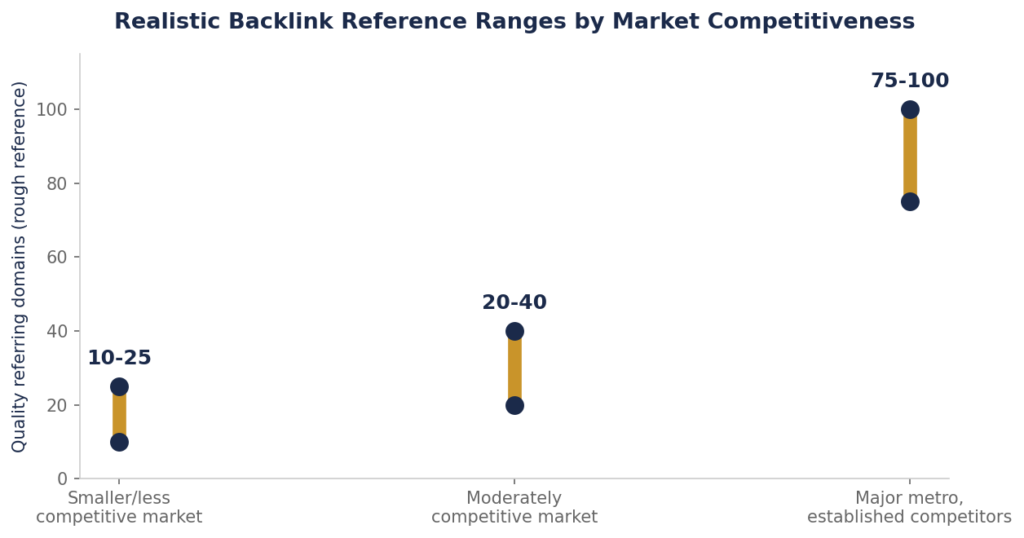
While there’s no single correct number, a few reference points help calibrate realistic expectations without treating them as a target to hit mechanically. A newer medical malpractice firm competing in a moderately competitive market might realistically need somewhere in the range of 20-40 genuinely quality referring domains before seeing meaningful movement on competitive case-type terms, based on typical competitive benchmarking patterns in this niche. A firm competing in a major metro against long-established competitors may find the realistic competitive baseline considerably higher — sometimes 75-100-plus quality referring domains for the single broadest head term specifically, which is exactly why the case-type strategy covered above matters so much for making competitive entry realistic without requiring that scale of link acquisition across the entire site at once.
These figures should be treated as rough orientation, not a target — the actual number for any specific firm’s actual target terms in their actual market is only knowable through the direct competitive benchmarking process covered above.
The Highest-Value Sources Specifically for Medical Malpractice
Given how much digital consensus and source quality matter more than raw count, it’s worth naming the specific source types that carry the most weight for this niche specifically: state bar association publications and journals, recognized legal news publications (Law360, Legal Affairs, and similar), genuine medical-adjacent publications meeting the credentialing standards covered elsewhere in this cluster, and institutional .edu/.gov sources where genuine topical relevance exists.
A firm’s link acquisition strategy should weight pursuit of these specific source types disproportionately relative to generic legal directories or general guest posting, given how much more these sources contribute to both traditional ranking signals and the digital consensus evaluation increasingly shaping how search systems assess credibility in 2026.
A Worked Example: Benchmarking a Real Target Term
Walking through the actual process makes this concrete. Consider a firm wanting to compete for “birth injury lawyer” in a mid-sized metro market. The benchmarking process starts by pulling the top five ranking pages for that exact term in that specific market — not the national average, since local competitive intensity varies significantly by market size.
Checking referring domain counts for each of those five pages using a standard SEO tool reveals a range, say from 18 to 45 referring domains across the top five results, with the page ranking first showing 45 and the page ranking fifth showing 18. This immediately tells the firm something more useful than any generic industry number: the realistic competitive threshold for page-one contention in this specific market for this specific term sits somewhere in the high teens to low forties, not an arbitrary industry-wide figure.
The next step goes beyond the count alone — reviewing what those referring domains actually are. If the top-ranking page’s 45 referring domains include several state bar mentions, a local news feature, and a handful of genuinely relevant legal directories, that’s a meaningfully different profile than 45 generic guest post placements would represent, even at the same raw count. This qualitative check is exactly why raw benchmarking numbers alone remain incomplete without the source-quality and digital consensus considerations covered throughout this guide.
Why Firms Consistently Overestimate What They Actually Need
It’s worth naming a common pattern directly: firms and even some providers routinely overestimate the raw backlink volume needed to compete, often because vendor sales pitches lean on large volume numbers as an easy way to demonstrate value, even when that volume doesn’t map to what competitive benchmarking actually shows is necessary.
This matters practically because a firm sold on acquiring 100 backlinks over six months, based on a generic industry benchmark rather than genuine competitive analysis of their specific target terms, may end up spending significantly more than necessary while accepting lower average link quality to hit that volume target within budget. A firm that instead benchmarks its actual competitive gap might discover it genuinely needs 25-30 quality links, not 100, allowing that same budget to be spent on meaningfully higher-quality individual placements instead of stretched thin across volume.
Tools and a Practical Monitoring Cadence
Running the competitive benchmarking process described above doesn’t require expensive infrastructure. A standard SEO tool subscription — Ahrefs, Semrush, or a comparable alternative — provides the referring domain counts and source-quality visibility needed for the initial competitive analysis. Google Search Console’s own Links report, while limited to a sample rather than a comprehensive view, offers a free starting point for monitoring a firm’s own existing profile even without a paid tool subscription.
For ongoing monitoring rather than a one-time initial analysis, setting up recurring competitive checks — quarterly, as covered in the FAQ below — keeps a firm’s understanding of what “enough” looks like current as competitor profiles evolve. This is particularly important for a case-type content strategy, since a firm actively publishing new case-type pages should periodically re-benchmark each new target term independently rather than assuming a single site-wide competitive assessment applies uniformly across every case type being pursued.
How This Changes as a Firm’s Case-Type Content Matures
A firm early in building out its case-type content cluster should expect the realistic backlink threshold for each new page to be relatively achievable, since narrower case-type terms typically carry less entrenched competition than a firm’s broader head terms. As a firm’s overall domain authority and digital consensus strengthen through this cumulative work, each subsequent case-type page often requires proportionally fewer dedicated backlinks to compete, since the page benefits from the firm’s overall growing site-wide authority and consensus strength rather than needing to build competitive standing entirely in isolation.
This compounding effect is one of the strongest practical arguments for the case-type content strategy discussed throughout this cluster — not just as a content strategy in isolation, but as a structural advantage that makes each subsequent link building effort more efficient than the last, provided the underlying digital consensus foundation stays solid throughout.
Why This Framework Matters Beyond Just Answering the Original Question
Stepping back, the shift from “how many backlinks” to competitive benchmarking plus digital consensus reflects something broader about how SEO strategy has matured in this space. Treating link acquisition as a numbers game to hit — regardless of source quality or how those links fit into a firm’s broader entity consistency — was always a simplification that happened to work reasonably well when search algorithms were less sophisticated at evaluating quality and trust directly. That simplification holds less and less as evaluation systems get better at distinguishing genuine authority from raw volume.
For a firm building a medical malpractice link building strategy in 2026, this means the most durable competitive advantage doesn’t come from finding a way to acquire more links faster than competitors — it comes from building genuinely stronger digital consensus, pursuing genuinely higher-value institutional sources, and structuring content around case-type specificity in a way that makes each subsequent competitive gain more achievable than the last. The firms still asking “how many backlinks do I need” as their primary strategic question are working from a framework that 2026’s evaluation systems have already moved past.
Frequently Asked Questions
Is there any realistic scenario where a firm genuinely needs to count and target a specific backlink number?
Competitive benchmarking against what’s actually ranking, as covered above, produces something closer to a realistic reference range for a specific firm’s specific target term — but this should be understood as directional competitive context, not a literal target to hit mechanically before expecting results, since link quality and digital consensus matter more than reaching any specific count.
How does digital consensus interact with the case-type content strategy covered elsewhere in this cluster?
They reinforce each other directly — a firm with strong digital consensus (consistent NAP, clean entity signals) gets more value from the backlinks it earns pointing at each case-type page, while genuinely deep, well-differentiated case-type content gives outside sources more specific, citable material to link to in the first place, compounding both effects together rather than operating independently.
Should a firm prioritize fixing digital consensus issues before or after starting new link acquisition?
Before, or at minimum simultaneously rather than after. Since digital consensus affects how much value new links actually deliver once earned, pursuing aggressive link acquisition while NAP inconsistencies or conflicting directory information remain unresolved means new links are working against a weaker foundation than they otherwise would.
How can a firm check its own digital consensus status across the web?
A manual audit searching the firm’s name and checking every major directory listing, citation, and mention for consistency is the most direct method, though several SEO tools now offer automated NAP consistency checking across common directory sources, which can speed up identifying discrepancies across a large existing footprint.
Does a firm with genuinely fewer but higher-quality backlinks ever outrank a competitor with a larger volume of lower-quality links?
Yes, and this is increasingly the norm rather than the exception given how directly source quality and digital consensus factor into 2026 ranking evaluation. A firm with a smaller number of institutional, high-trust links and strong consensus across its citation footprint frequently outperforms a competitor with a larger raw link count built from lower-quality, less consistent sources.
How often should a firm re-run the competitive benchmarking process to check whether its link profile is still competitive?
Roughly every six months is a reasonable cadence for most firms, since competitor link profiles and the broader competitive landscape shift gradually rather than requiring constant monitoring, though firms in especially aggressive, fast-moving markets may benefit from a more frequent quarterly check.
Does the digital consensus concept apply equally to a firm’s overall brand and to individual case-type pages specifically?
Primarily to the overall firm entity — NAP consistency, business identity signals — rather than to individual pages directly, though a stronger overall digital consensus benefits every page on the site, including case-type pages, by strengthening the foundational trust the whole domain is evaluated against.
Is it possible for a firm to have too many backlinks relative to what its competitive position actually requires?
Not in the sense of raw count being harmful on its own, but a firm that has vastly outpaced what competitive benchmarking shows is necessary, particularly if that volume was achieved through lower-quality, high-velocity acquisition rather than genuine quality growth, risks the same unnatural-pattern concerns covered in the toxic backlink guidance elsewhere in this cluster — the concern is quality and velocity, not simply having “too many” genuinely earned, high-quality links.
The Bottom Line
There’s no universal backlink count that guarantees a medical malpractice firm ranks for competitive terms — the real answer depends on direct competitive benchmarking against what’s actually ranking for a firm’s specific target terms in its specific market, a case-type content strategy that makes competitive entry realistic without requiring enormous link volume against a single broad term, and increasingly, the digital consensus concept that reframes quality and consistency as more consequential than raw count. Firms chasing a specific number without this broader context are optimizing for the wrong target; firms that benchmark realistically, fix their foundational digital consensus, and then pursue genuinely high-value sources are working with a framework that actually reflects how this niche’s rankings get determined in 2026and 2027.