
Legal Guest Posting for Medical Malpractice: LegallyRank vs Generalist Providers
A medical malpractice firm shopping for link building help usually ends up comparing two very different kinds of provider without quite realizing it: a generalist that sells legal guest posting to law firms of every kind, and a specialist brokerage that vets placements around one niche. Both can be legitimate businesses. They are not built for the same buyer, and in a practice area that carries both legal and health YMYL scrutiny, the difference shows up in vetting depth, publisher fit and risk long before it shows up in the invoice.
This comparison lays out how each model works, where each is genuinely strong, where each strains for medical malpractice specifically, and how to decide in 2026/27. It is written by a specialist brokerage, so read the LegallyRank sections with that in mind. The goal is to give you criteria you can verify with any provider, including us, rather than ask you to take a positioning claim on faith.
The Three Provider Types You Are Actually Choosing Between
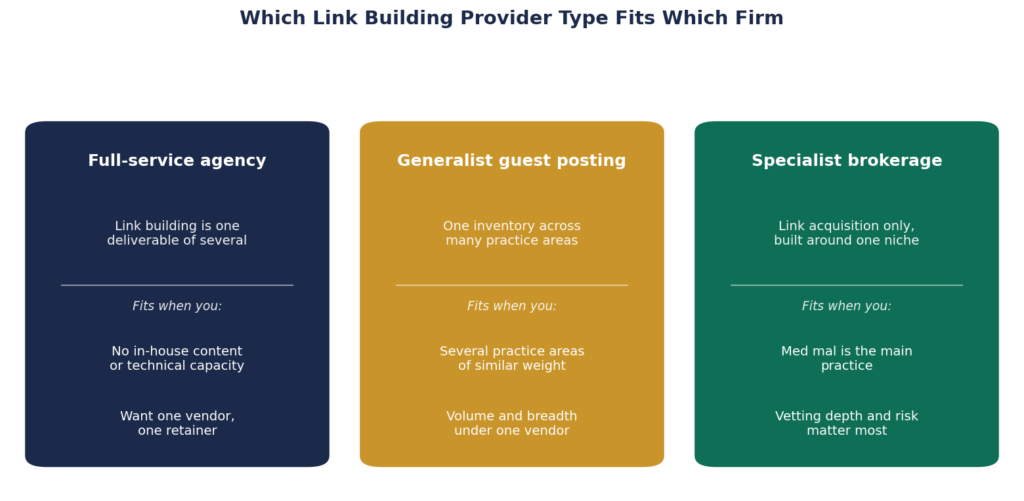
Full-service legal SEO agencies. These bundle link building with content, technical SEO, local optimization and, increasingly, AI-visibility work, usually on a monthly retainer. Link building is one deliverable among several, which is convenient but makes it harder to judge the quality of that single component on its own. The earlier comparison of medical malpractice link building services in this cluster covers this category in detail, so this post concentrates on the other two.
Generalist legal guest posting providers. These sell guest post placements and outreach to law firms across practice areas. Legal Guest Post, for example, describes its own offering as legal guest blogging, link building for law firms and lawyers, and legal blogger outreach, connecting firms with legal blogs and offering a free list of legal guest posting sites. The common feature of this category is one inventory serving many practice areas: family law, criminal defense, estate planning and personal injury all draw on the same pool of publishers.
Specialist link building brokerages. These do one thing, link acquisition, and narrow it to a niche. LegallyRank works this way. The work is sourcing and vetting placements, not designing websites, running content retainers or managing paid search. The trade is a narrower menu in exchange for more depth on the part of the work the firm actually hires them for.
For a medical malpractice firm that already has content and technical foundations in place, the live decision is usually between the second and third types. That is the comparison the rest of this guide makes.
Why Medical Malpractice Changes the Comparison
Generalist and specialist providers can look nearly identical on a pricing page. Four features of this practice area are what pull them apart in practice.
Double YMYL scrutiny. Medical malpractice content sits where legal and health quality standards both apply. A placement that would pass unnoticed in a lower-stakes niche gets examined more closely here, and a backlink profile that looks manufactured carries more downside.
A publisher landscape that differs from general legal. Beyond legal directories and bar publications, a med mal firm has access to medical-adjacent publications, patient advocacy organizations and institutional health sources. A provider whose inventory is built around general legal blogs may not have meaningful access to that tier at all.
Credentialed authorship and sourcing standards. The vetting checklist covered earlier in this cluster adds medical-specific checks to the usual traffic and outbound-link review: named, credentialed authorship, primary-source citation quality, a documented editorial policy and sponsored-content disclosure. A provider can only apply those checks if its process includes them.
Case value. A single retained medical malpractice case can be worth many multiples of a year’s link building budget. That makes the sticker price of a placement a small number relative to a good outcome, and it makes cutting corners on vetting a poor trade, because the risk side of the ledger is the part that does not scale down.
How the Specialist Brokerage Model Works
A specialist brokerage’s pitch is depth on a narrow task. In LegallyRank’s case, that shows up in a handful of concrete, checkable practices:
- Vetting happens before a site is offered. Traffic is checked independently of domain metrics, the outbound link neighborhood is reviewed, and the site is screened for network footprints. For medical malpractice, the medical-specific checks from the vetting checklist are layered on top.
- The site is disclosed before you pay. You can run your own audit using the six-step process described earlier in this cluster. If a provider will not tell you which site you are buying until after payment, treat that as a warning sign regardless of provider type.
- Anchor text is a shared decision. Branded and naturally varied anchors are the default, and exact-match commercial phrases are treated as the exception, consistent with the anchor ratios covered earlier in this cluster.
- Pricing structures are explained. Cost differences between placements are tied to authority, real traffic, relevance and content requirements, so you can see what you are paying for.
- The education layer is public. Publishing the reasoning behind vetting decisions lets you test a provider’s thinking before you commit budget.
None of this is exclusive to specialists in principle. A generalist could do all of it. The difference is that a specialist’s entire operating model depends on doing it well in one niche, while a generalist has to spread that rigor across every practice area it sells to.
What Generalist Legal Guest Posting Providers Do Well
An honest comparison has to give the generalist model its due, because there are real situations where it is the better fit.
Breadth under one vendor. A firm handling several practice areas of roughly equal weight can manage one relationship instead of several. That reduces coordination overhead and keeps reporting in one place.
Speed and volume. A broad inventory can mean faster turnaround and a larger pool to draw from, which matters for a firm that needs steady placement volume across many topics.
Lower overhead. One marketing publication’s balanced comparison of generalist and specialist agencies credits generalists with basic setup competence, broad digital skills and lower overhead, and lists a narrower service menu and sometimes a higher price as the cost of going specialist. That is a fair summary, and it applies to link building as much as to any other service.
A reasonable starting point for general legal content. For content that only touches medical malpractice lightly, such as a general legal explainer on a law-firm blog, a well-run generalist can place it perfectly well.
Where the Generalist Model Strains for Medical Malpractice
The strain points are specific, and every one of them is something you can test before you buy.
Inventory depth in the medical-adjacent tier. A generalist’s best publishers are usually legal blogs and business sites. If you ask for health-focused or patient advocacy placements and the answer is a general legal blog with an occasional health post, that tells you where the inventory actually sits.
Authorship and sourcing standards. Medical-legal placements need credentialed authorship and primary-source citations. Providers that sell placements as a bulk content product often have no step in their process for either.
Anchor patterns. Bulk packages tend to default to the easiest anchor text to administer, which is frequently the firm’s main target keyword repeated across placements. In a niche with elevated YMYL scrutiny, that pattern is the one most worth avoiding.
Risk is concentrated where scrutiny is highest. One specialist agency has published a case study of a personal injury firm that received a manual action after a generalist built links on irrelevant sites such as technology blogs and recipe sites, with the agency reportedly dismissing the warning. That is a vendor-published anecdote and should be read that way, but the pattern it describes, links with no topical connection to the practice area, is exactly what the vetting steps in this cluster are designed to catch.
Medical-legal pricing is hard to hit with a flat package. Industry pricing analyses cited elsewhere in this cluster put healthcare link placements well above general legal pricing, with credentialed authorship adding a further cost layer. A bulk package priced far below those ranges cannot be funding the review that medical-legal content requires.
Side-by-Side: How the Two Models Compare
| Factor | Generalist legal guest posting | Specialist brokerage |
|---|---|---|
| Inventory focus | Many practice areas, one pool | One niche, built around it |
| Medical-adjacent publishers | Often limited | Core to the model, if the provider has built it |
| Vetting depth | Varies widely by provider | The main thing being sold |
| Site disclosure before payment | Varies | Should be standard |
| Anchor text control | Often defaulted by the provider | Shared and varied by default |
| Service menu | Link building, sometimes content | Link building only |
| Best when | Several practice areas, volume needed | Med mal is the main practice, risk matters |
Treat this table as a set of typical tendencies, not guarantees. Individual providers in either column vary, which is why the questions later in this guide matter more than the category label.
How Pricing Differs in Practice
Specialization does not automatically mean a higher price. Pricing follows the quality of the site, the traffic behind it and the content involved far more than it follows the provider’s category. A generalist selling a genuinely vetted, relevant placement and a specialist selling the same site should land in a similar range.
What does differ is what the price includes. Industry pricing analyses put healthcare link building well above general legal rates, with credentialed review adding a separate premium on top. When you compare quotes, ask each provider to state what is in the number: who writes the content, who provides credentialed review, how many revision rounds are included and whether the site is named before payment. Two quotes that look different on the surface often turn out to cover different amounts of work.
A quote far below the benchmarks for the stated authority and niche deserves scrutiny from either type of provider. The earlier pricing guide in this cluster walks through how to check whether a number’s components add up.
A Worked Scenario: Matching Provider to Firm
Consider two firms.
The first is a four-attorney practice where medical malpractice makes up most of the caseload, with a handful of general personal injury matters on the side. It has solid case-type pages and a marketing coordinator, but its backlink profile is thin and mostly directory-based. Its gap is specifically link acquisition, and the cost of a poorly vetted placement is high because the whole site’s reputation rests on one practice area. A specialist brokerage fits this firm: the vetting depth and the medical-adjacent publisher focus address its actual gap.
The second is a twelve-lawyer firm covering medical malpractice, family law, criminal defense and estate planning, each practice area with its own pages. It needs steady placements across all four and has limited bandwidth to manage several vendors. A generalist may well be the more practical choice for the bulk of that volume, with a specialist engaged separately for the medical malpractice pages, where the stakes and the publisher requirements are highest.
The second firm’s answer is a hybrid, and it is common. The one thing to manage in a hybrid is anchor text and link velocity across both providers combined, so the overall profile still looks natural.
What a Specialist Brokerage Does Not Do
A comparison that only lists strengths is not much use, so here are the limits of the specialist model.
It does not fix your site. Placements amplify what is already on your pages. If your case-type content is thin or your attorney bios lack real credentials, backlinks will not close that gap. The ranking-factors guide earlier in this cluster explains why content depth and credentials have to be solid first.
It does not replace a full-service retainer if you need one. A firm without in-house content or technical capacity may be better served by a full-service agency, with link building as one part of the scope.
Its niche inventory takes time to build and should be verified. A specialist’s medical-adjacent publisher relationships are only as good as the sites it can actually name. Ask any specialist, including us, to show you real examples of medical-legal placements and run your own audit on them. If the answer is vague, the specialization claim is marketing.
It carries a narrower menu. The same trade-off that makes a specialist deeper makes it less convenient. You may end up coordinating with a separate provider for content or technical work.
How to Pilot a Provider Before Committing Budget
The safest way to compare a generalist and a specialist is to test each on a small, low-stakes engagement before committing to a program. A pilot costs little and tells you far more than a sales call.
Start with a single placement from each provider you are considering, on a page that matters but is not your most important one. Before approving anything, run the six-step audit from earlier in this cluster on the proposed site: check traffic independently, review the outbound link neighborhood, confirm named and credentialed authorship, look at citation quality, note how difficult the editorial process is and confirm sponsored-content disclosure. Keep the results in a simple shared spreadsheet so you can compare providers on the same criteria rather than on impressions.
After publication, check three things. Is the placement live and indexed after a few weeks? Does the published piece match what was agreed on anchor text, authorship and disclosure? And was the process transparent, with the site named upfront, revisions handled cleanly and questions answered directly? A provider that clears the audit but is evasive during the process is telling you something about how they will behave when a problem comes up later.
Give each pilot a defined window, usually four to six weeks, and decide in advance what a pass looks like. Firms that skip this step tend to commit to a package based on a persuasive pitch and discover the gaps only after several placements are already live, when correcting course is slower and more expensive. A small pilot also makes the hybrid option easier to evaluate, because you can see where each provider is strongest before assigning them different parts of the work.
Questions to Ask Any Provider Before You Commit
These apply to a generalist, a specialist or a full-service agency, and the quality of the answers tells you more than the category label does.
- Can you name the exact sites you are proposing before I pay, and show real traffic data for them?
- How do you check outbound link neighborhoods and network footprints?
- For medical-legal placements, do you require named, credentialed authorship and primary-source citations?
- Who decides anchor text, and what is your default ratio across placements?
- Can you show me past medical-adjacent or health-focused placements, and are they still live?
- What happens if a placement is removed or deindexed after publication?
- How is the price built: placement, content, review and revisions?
A provider that answers these specifically is showing real process. Vague or evasive answers are a red flag whichever category the provider sits in.
Frequently Asked Questions
Is a specialist brokerage better than a generalist for medical malpractice link building?
Usually yes when medical malpractice is your main practice, because the vetting depth and medical-adjacent publisher focus address the places generalists most often fall short. It is not automatic, though, and a well-run generalist can beat a poorly run specialist, so verify the provider’s process rather than trusting the label.
Can a medical malpractice firm use both a generalist and a specialist?
Yes, and many multi-practice firms do. Use the generalist for volume across other practice areas and the specialist for medical malpractice pages, and coordinate anchor text and link velocity across both so the combined profile stays natural.
Does a specialist cost more than a generalist?
Not necessarily. Price follows site quality, traffic, content and credentialed review more than provider category. Compare what each quote includes, not just the total.
What should I ask a generalist provider before buying medical-legal placements?
Ask for the site name and traffic data before payment, whether credentialed authorship and primary-source citations are required, who controls anchor text and whether they can show past health-focused placements that are still live. Their answers show whether their process covers medical-legal content at all.
Does a lower price from a generalist mean lower quality?
Not automatically, but a price far below industry benchmarks for the stated authority and niche warrants scrutiny. Quality placements require real review and real traffic, which cost money to maintain.
How can I verify a specialist’s medical malpractice claims?
Ask for named example placements and run your own audit using the six-step process described earlier in this cluster. Check traffic, outbound links, credentialed authorship, citation quality and disclosure on each site yourself.
Should I switch providers mid-campaign?
Review your existing placements first. Check which are still live and indexed, audit your anchor text distribution and confirm any exclusivity terms before moving. A new provider’s placements should complement the existing profile, not duplicate its patterns.
Does specialization matter if my firm also handles general personal injury?
It matters most for the medical malpractice pages. A hybrid approach, with a specialist for those pages and either provider type for general personal injury, often fits firms with a split caseload.
The Bottom Line
Generalist legal guest posting providers and specialist brokerages both operate legitimately, but they are built for different buyers. A generalist suits a multi-practice firm that needs breadth, volume and one vendor to manage. A specialist suits a firm where medical malpractice is the main practice and the cost of a poorly vetted placement is high, because its vetting and publisher focus are built around that risk. Neither label guarantees quality, so judge providers by what they can show you: named sites before payment, real traffic, credentialed authorship, natural anchors and past placements that are still live. Ask us the same questions, and hold every provider to the same standard.