How Medical Malpractice Firms Use Journalist Queries for High-Authority Backlinks
Source of Sources, one of several platforms that emerged after HARO’s original free model fragmented, delivers a documented 36 percent dofollow link rate across placements — the highest of any platform currently tracked in the category. That’s a genuinely useful, current data point for a medical malpractice firm evaluating where to invest limited outreach time, and it points at something worth understanding before diving into tactics: the journalist query platform landscape has changed meaningfully, and medical malpractice firms have specific advantages worth leveraging that generic guidance rarely addresses.
This guide covers the current 2026/27 platform landscape, what makes medical malpractice content genuinely attractive to journalists right now, and a specific, authoritative data source worth building outreach around.
The Current Platform Landscape, Current as of 2026/27
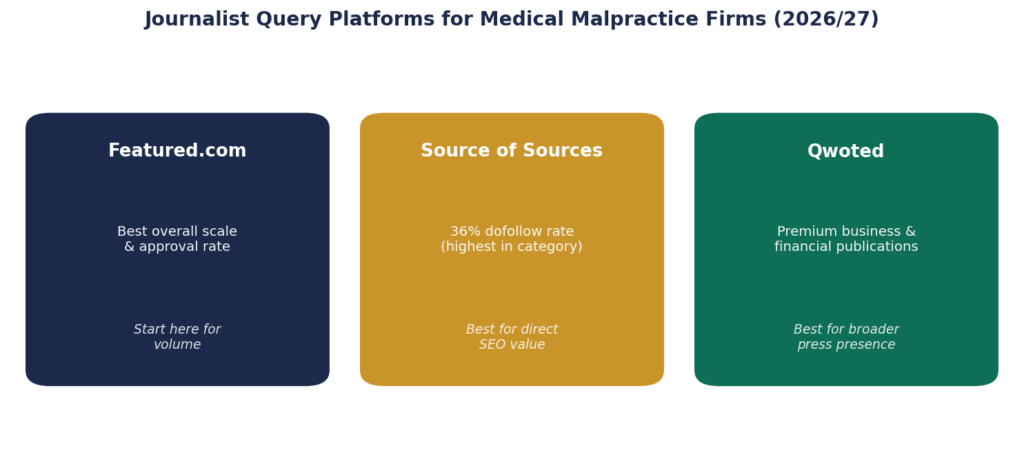
The original free HARO model fragmented following ownership changes, and several platforms have emerged to fill different parts of that gap. Featured.com currently ranks as the strongest option for scale and approval rate, sending a steady stream of categorized journalist questions with defined word limits and deadlines, reviewed by an editorial team before acceptance into their publisher network. Qwoted operates on a different model entirely — a matchmaking system where you build an expert profile and set topic alerts, generally positioned toward premium business and financial publication coverage. Source of Sources, founded by HARO’s original creator specifically to fill the gap left by platform changes, currently delivers the strongest dofollow link rate in the category at 36 percent, making it a particularly strong choice when the direct SEO value of the resulting link matters as much as the exposure itself.
For a medical malpractice firm specifically, the practical approach isn’t picking one platform and committing exclusively — it’s understanding that different platforms serve different purposes, and using more than one costs primarily time rather than meaningful additional budget given most offer accessible free or low-cost entry tiers.
Why Medical Malpractice Content Is Genuinely Attractive to Journalists Right Now
Beyond the platform mechanics, it’s worth understanding why this specific moment offers real opportunity for medical malpractice attorneys willing to engage with journalist queries consistently. Healthcare and medical liability topics are receiving sustained, active press attention — AI’s growing role in clinical decision-making and the liability questions it raises, ongoing legislative activity around malpractice reform in various jurisdictions, and recurring coverage of specific malpractice risk patterns by specialty are all active, current journalism beats with genuine demand for qualified legal commentary.
This matters practically because journalists covering these topics need attorneys who can speak credibly to both the legal and medical dimensions of these stories — exactly the dual expertise a genuine medical malpractice practice offers, and exactly the kind of specific, qualified source journalists actively struggle to find quickly when working on deadline. A firm responding promptly and substantively to a query about, for instance, the liability implications of AI-assisted diagnosis errors, is positioned to become a go-to source for that reporter on future related stories, not just a one-time quote.
Building Original Research Around the NPDB
This connects directly to the original-research-as-digital-PR-bait tactic covered elsewhere in this cluster, and medical malpractice has access to a specific, genuinely authoritative public data source most firms never think to use directly: the National Practitioner Data Bank’s own Data Analysis Tool, which generates datasets covering adverse action and medical malpractice payment reports from 1990 through the present, released specifically to facilitate research on malpractice, licensing, and quality assurance issues.
A firm willing to invest the analysis time to pull genuine, original patterns from this public dataset — trends in payment reports for a specific specialty, state-level comparison data, patterns in a particular type of adverse action — has access to primary source material that didn’t previously exist in that specific analyzed form, giving journalists and publications a genuine reason to cite the firm as an original source rather than one voice among many offering commentary on an already-circulating story.
How to Actually Respond to Queries Effectively
Given how saturated these platforms have become with generic or AI-generated responses, a few practical principles separate submissions that get used from those that get ignored. Speed matters disproportionately — journalists on deadline typically use the first genuinely useful responses they receive, meaning checking and responding within the first hour of a relevant query appearing meaningfully outperforms a stronger response submitted a day later. Specificity beats generality — a response referencing a specific pattern from real case experience, a concrete statistic, or a precise legal distinction reads as genuinely authoritative in a way generic “medical malpractice involves several factors” language does not. And precise topical matching outperforms broad applicability — responding only to queries where a firm’s actual expertise is a credible, specific match produces better pickup rates than stretching to respond to tangentially related queries simply to increase response volume.
Comparing the Platforms on What Actually Matters for Medical Malpractice
Beyond the general strengths and weaknesses covered above, it’s worth evaluating these platforms specifically against what a medical malpractice firm needs. Featured.com’s broad publisher network and strong approval rate make it a reasonable default starting point given its accessibility and volume of genuinely relevant healthcare and legal category queries. Qwoted’s premium business and financial publication focus is a stronger fit for a firm specifically pursuing high-authority, non-health-specific coverage — useful for broader brand-building commentary but less consistently aligned with medical-legal query volume specifically. Source of Sources’ documented dofollow advantage makes it the strongest single choice when the direct backlink value matters as much as the exposure itself, which for most medical malpractice firms building a link building strategy around this cluster’s broader framework, is frequently the primary goal.
This suggests a practical prioritization for a firm with limited time to monitor multiple platforms: start with Featured.com for volume and accessibility, add Source of Sources specifically for its dofollow advantage once the basic response workflow is established, and consider Qwoted only once a firm has the bandwidth to pursue a broader, non-health-specific press presence beyond the immediate medical malpractice content this cluster focuses on.
A Practical Weekly Workflow
Given the current platform landscape, a sustainable approach doesn’t require daily obsessive monitoring. Checking Featured.com and at minimum one additional platform — Source of Sources given its strong dofollow rate, or Qwoted if premium business publication coverage is a specific goal — once or twice daily during business hours catches the large majority of genuinely relevant opportunities without consuming excessive time. Setting up keyword alerts for medical malpractice, healthcare liability, patient safety, and related terms where the platform supports this functionality reduces the time spent scanning irrelevant queries.
Maintaining a short, living document of case-pattern observations, relevant statistics, and genuine insights an attorney can draw on quickly when a relevant query appears means responses can be specific and substantive without requiring extensive research under deadline pressure for each individual query.
A Worked Example: Turning a Current News Cycle Into a Placement
Making this concrete helps more than the principle alone. Consider the current, active coverage of AI tools being used in clinical decision-making and the liability questions this raises — a topic receiving sustained press attention right now, including commentary from major AI companies about whether avoiding AI-assisted diagnosis could itself constitute a form of medical negligence.
A medical malpractice attorney monitoring Featured.com or Source of Sources for queries touching healthcare technology, AI liability, or medical negligence standards is well-positioned to respond with genuinely specific commentary: how existing standard-of-care frameworks might apply to a physician’s decision to use or not use an AI diagnostic tool, what precedent exists for liability when a human clinician overrides or defers to an algorithmic recommendation, or how this emerging area intersects with established informed consent requirements. This is exactly the kind of substantive, legally grounded commentary journalists covering this beat need and often struggle to find quickly — a genuine opportunity for a firm willing to engage with an actively developing story rather than only pursuing evergreen, non-time-sensitive topics.
Why Timeliness Matters More for This Tactic Than for Most Other Link Building Approaches
Journalist query response is distinct from most other link building tactics covered throughout this cluster in one important way: the value of a given opportunity decays quickly. A query posted this morning about a breaking healthcare liability story will likely be filled by the time a firm gets around to responding next week, where a guest post opportunity or a scholarship program submission remains equally viable whether pursued today or next month.
This reinforces why building the consistent daily or near-daily checking habit covered in the practical workflow section matters more for this specific tactic than for almost any other approach in a firm’s broader link building strategy. A firm that treats this as a weekly batch task, checking platforms once every several days, will consistently miss the time-sensitive opportunities — like the AI liability example above — that represent some of the strongest-fit, most genuinely newsworthy opportunities available.
Common Mistakes Firms Make With This Channel
Responding only to queries explicitly labeled “medical malpractice” rather than the broader healthcare liability and patient safety topic space. Many genuinely relevant query opportunities arrive framed around adjacent topics — healthcare technology, patient rights, hospital policy — rather than using the exact phrase “medical malpractice,” and firms filtering too narrowly by keyword miss real opportunities within this broader territory.
Treating the NPDB data tactic as a one-time project rather than a recurring content asset. A firm that pulls genuine original analysis from NPDB data once, uses it for a single pitch, and never revisits it misses the compounding value of periodically updating the same analysis and repitching it as fresh, current data — particularly valuable given how actively journalists are covering healthcare liability trends right now.
Submitting responses that read as generic legal boilerplate rather than genuinely specific commentary. Given how much query volume on these platforms is now low-effort or AI-generated, a response that doesn’t include a specific, concrete detail — a precise legal standard, a specific case pattern, an actual statistic — blends into that same generic noise rather than standing out as genuinely authoritative.
Abandoning the channel after a slow initial period without reassessing approach. Pickup rates genuinely improve as a firm builds familiarity with what specific publications and journalists are looking for — a firm that gives up after two or three weeks of limited results is often stopping right before the improvement curve this channel typically follows would have started showing results.
How This Fits Into a Firm’s Broader Digital PR Strategy
Journalist query response shouldn’t function as a firm’s sole digital PR tactic, even with the current platform landscape and timely healthcare liability news cycle covered throughout this guide. It works best as one component of a broader approach that also includes the genuine original research tactic covered above, pitched proactively rather than only in response to inbound queries, and the editorial-versus-guest-post weighting relevant to a firm’s overall link building strategy more broadly.
Firms running this channel most effectively tend to treat query response as the fast, reactive layer of their digital PR effort — catching time-sensitive opportunities as they appear — while simultaneously building longer-term original research and press relationships that don’t depend on reacting quickly to an inbound query. This combination produces more consistent results than either approach pursued in isolation, since reactive query response alone leaves genuine gaps during periods when few directly relevant queries happen to appear, while original research and proactive pitching alone misses the fast-turnaround opportunities a current, actively developing story like the AI liability coverage represents.
Frequently Asked Questions
Which journalist query platform should a medical malpractice firm prioritize if only pursuing one?
Featured.com is the strongest single choice for most firms given its current scale and approval rate advantage, though a firm specifically prioritizing the direct SEO value of resulting links should weight Source of Sources more heavily given its documented 36 percent dofollow rate.
How much time does maintaining an effective journalist query response practice typically require?
Fifteen to thirty minutes of focused daily attention, checked once or twice during business hours, is generally sufficient to catch and respond to the most relevant opportunities without requiring constant monitoring throughout the day.
Is the NPDB data genuinely accessible to a firm without a dedicated research team?
Yes — the Data Analysis Tool is a free, public resource designed specifically to generate research-ready datasets without requiring specialized database expertise, making genuine original analysis accessible to firms of any size willing to invest the time to work with the data directly.
Does responding to journalist queries about AI and healthcare liability specifically require specialized technical expertise?
Not necessarily — journalists typically need legal commentary on liability frameworks and precedent, not deep technical AI expertise, meaning a medical malpractice attorney’s genuine legal expertise remains the primary qualification even when the underlying story involves emerging medical technology.
How does a firm know if a journalist query response actually resulted in a published mention?
Most platforms don’t automatically notify sources when a response is used, making periodic manual checking of relevant publications, or setting up a Google Alert for the firm’s name, generally necessary to track actual pickups accurately.
Should responses to journalist queries be written by an attorney personally, or can marketing staff draft them?
Either can work provided the response reflects genuine, specific expertise — some firms have marketing staff draft an initial response based on a brief conversation with the attorney, with the attorney reviewing and adding case-specific detail before submission, balancing response speed against the authenticity that makes these responses effective.
Is it worth pursuing journalist query response for a newer medical malpractice firm without an established reputation?
Yes — this channel is specifically accessible to newer firms since journalists evaluate the quality and specificity of a given response more than the respondent’s existing reputation, making it one of the more accessible digital PR tactics available even before a firm has built significant case history or press relationships.
Are there compliance considerations specific to attorneys responding to journalist queries about current events like AI in healthcare?
Yes — standard attorney advertising and professional responsibility rules continue to apply to public commentary on current events, meaning responses should stay framed as general legal and policy commentary rather than specific advice to any individual, and should avoid discussing specific pending matters or client situations even when a current news story feels directly relevant to a firm’s actual casework.
How does using multiple journalist query platforms simultaneously affect response quality and consistency?
Using more than one platform increases the volume of opportunities a firm sees, but maintaining the same standard of specificity and genuine expertise across every response, regardless of which platform it came through, matters more than platform count alone — a firm spreading thin, lower-quality responses across many platforms typically sees worse results than one submitting fewer, more substantive responses through two well-chosen platforms.
Why This Channel’s Value Will Likely Keep Evolving
It’s worth closing with an honest note that mirrors a point relevant throughout this cluster: the specific platform landscape described in this guide will likely keep shifting, just as it already has multiple times since HARO’s original model existed. The underlying skill — responding quickly and specifically to genuine journalist need with real expertise — remains valuable regardless of which platform happens to be dominant when this guide is read. Firms building genuine proficiency in crafting strong, specific, timely responses are building a durable capability that transfers across whatever the platform landscape looks like next, rather than investing narrowly in mastering one specific tool’s interface or submission process.
The Bottom Line
The journalist query platform landscape has genuinely changed since HARO’s original free model, with Featured.com, Qwoted, and Source of Sources each serving different strategic purposes worth understanding rather than defaulting to whichever platform happens to be most familiar. Medical malpractice attorneys have real, current advantages in this space — active journalism demand around healthcare liability and AI, and access to the NPDB’s genuinely authoritative public data for original research — that most firms treating this as a generic legal PR tactic never fully capitalize on. The firms getting real value from this channel right now are building a consistent, fast-response habit across the platforms that actually fit their goals, not chasing the single “correct” platform name.