How to Master Niche Relevance for Medical Malpractice Links
Search volume for seo for healthcare as an exact phrase shows 110 searches per month with near zero difficulty. Search volume for ‘medical malpractice lawyer’ is 550,000 searches monthly.
That gap between the small B2B term and the large consumer term drives the comparison. Niche relevance and domain authority solve different problems, and firms chasing the wrong term suffer. Strategic content should align intent while balancing search volume and audience needs.
This breaks down what each actually measures, why domain authority alone consistently underperforms genuine niche relevance in this specific practice area, and how real keyword data confirms exactly why that gap exists.
What Domain Authority Actually Tells You
Domain authority, measured as Ahrefs’ DR, Moz’s DA, or Semrush’s Authority Score, is a link-graph strength metric. It shows how much link equity a site has built, largely independent of its topical connections. A site with a DR of 70 built from tech and finance has authority in abstraction but not topical relevance. In seo for healthcare, this matters for relevance in legal-medical queries.
This distinction matters because Google’s ranking systems increasingly evaluate topical relevance as a genuinely separate signal from raw link authority, not a byproduct of it. A high-authority link from a completely unrelated site passes some value, but meaningfully less than the same authority level would from a genuinely topically-connected source.
What Niche Relevance Actually Measures
Niche relevance asks a different question entirely: does this linking site’s content, audience, and editorial focus genuinely connect to medical malpractice, personal injury law, or healthcare specifically? This is closer to the tiered relevance framework worth applying to any guest post vetting decision — Tier 1 directly on-topic sources, Tier 2 genuinely adjacent ones, and so on — than it is to any single numeric score.
The real-world keyword data above illustrates exactly why this distinction has practical teeth. Notice that “personal injury law firm SEO” carries a CPC of $120.83 — nearly the highest commercial value in the entire dataset — despite modest search volume of only 590 monthly searches. This tells you something concrete: the businesses bidding on this term (agencies and providers targeting law firms specifically) are willing to pay an enormous amount per click because the buyers searching this exact, niche-specific phrase convert at extraordinarily high value. A generic, high-authority site with no genuine connection to this specific buyer intent doesn’t capture that value nearly as effectively as a genuinely niche-relevant source would, regardless of its raw authority score.
Why the Keyword Data Confirms This Isn’t Just a Theory
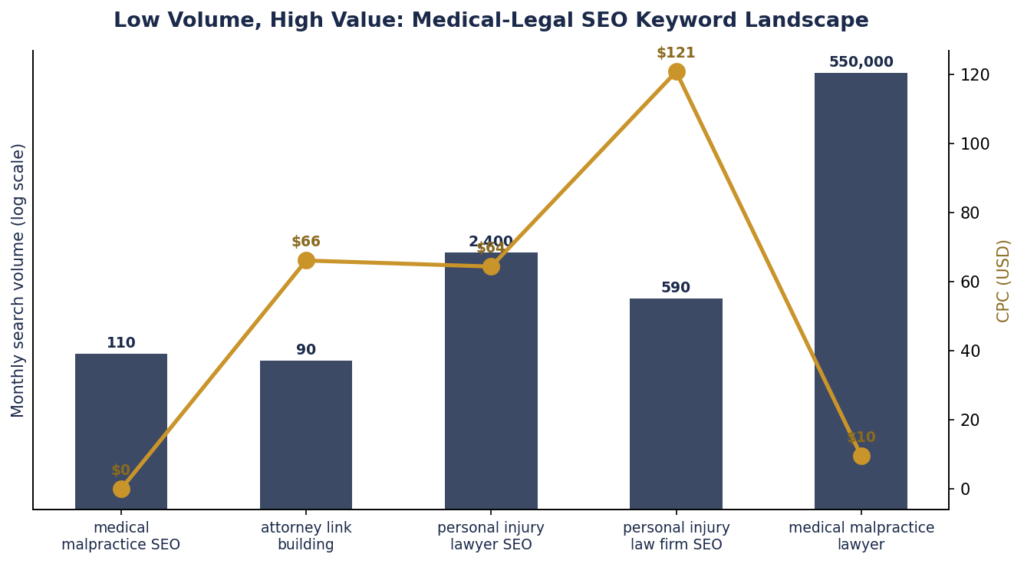
Beyond the CPC signal, the broader keyword landscape reveals more to understand.
Medical malpractice SEO is barely searched, with about 110 monthly searches and zero keyword difficulty.
Additionally, related terms have higher volume.
Medical SEO reaches 4,400 monthly searches.
SEO for doctors has 3,600.
The phrase seo for healthcare has 2,900.
This tells a medical malpractice firm’s content and link strategy something important: the exact-match niche term doesn’t carry enough volume on its own to build a strategy around, but the broader healthcare-and-legal-SEO semantic cluster does. This reinforces exactly why niche relevance — genuine topical connection across a cluster of related terms and concepts — matters more than chasing domain authority in isolation. A firm’s content and backlink profile should be built to demonstrate genuine expertise across this broader semantic territory, not narrowly optimized around a single low-volume exact phrase.
The Practical Test: Comparing Two Real Link Opportunities
Consider two hypothetical guest post opportunities a medical malpractice firm might be evaluating in the same week, using the keyword and relevance principles above rather than authority score alone.
Option A is a general business and finance blog with a domain authority in the high 60s, broad traffic, but no meaningful legal, medical, or healthcare content anywhere in its history. Option B is a healthcare-focused publication with a domain authority in the low 40s, more modest traffic, but consistent coverage of patient safety, medical error prevention, and healthcare accountability topics — genuinely within the “SEO for healthcare” and “medical SEO” semantic territory the keyword data shows carries real, if modest, search demand.
On raw authority score alone, Option A looks stronger. But given everything covered above — the CPC data showing niche-specific buyer intent commands outsized commercial value, and the semantic cluster data showing genuine healthcare topical relevance is where real (if modest) search volume actually concentrates — Option B is very likely the better placement for a medical malpractice firm’s actual goals, despite the lower raw score.
Why This Matters More for Medical Malpractice Than General Legal Practice Areas
This tension between authority and relevance exists across all legal link building, but it matters disproportionately more for medical malpractice specifically, for a reason the keyword data reinforces directly: this is a lower-search-volume, higher-commercial-value niche compared to broader personal injury or general legal practice areas. With “medical malpractice lawyer” itself carrying massive consumer search volume but the B2B and long-tail case-type terms carrying comparatively modest volume, every individual piece of content and every individual backlink needs to work harder, more precisely targeted at genuine topical relevance, than it would in a higher-volume, more forgiving practice area where raw authority alone has more room to compensate for weaker relevance.
How to Apply This When Evaluating Actual Prospects
Rather than treating authority score as a primary filter, a more effective evaluation sequence starts with relevance: does this site’s actual content history connect genuinely to medical malpractice, personal injury, healthcare, or the broader semantic cluster the keyword data reveals — patient safety, medical SEO, healthcare accountability — before checking its authority score at all. A site passing this relevance filter should then be evaluated on authority, traffic, and the medical-specific vetting checks covered elsewhere in this cluster as secondary factors, not the primary decision driver.
This sequencing matters because it’s easy to default to authority-first evaluation simply because it’s the faster, more mechanical check — pull a score, compare it against a threshold, move on. Relevance evaluation requires actually reading a site’s content and understanding its genuine topical focus, which takes more judgment and more time, but produces meaningfully better placement decisions given everything the keyword data above demonstrates about how concentrated and specific genuine buyer and search intent actually is in this niche.
Building a Keyword-Informed Prospect List, Not Just a Relevance Filter
The data above suggests a specific, practical prospecting method rather than just a general principle. Starting from the broader semantic cluster — medical SEO, SEO for doctors, SEO for healthcare, healthcare medical SEO, local SEO for medical professionals — a firm can identify genuinely topically-connected publisher candidates by researching who ranks for or genuinely covers these broader terms, rather than searching narrowly for sites discussing “medical malpractice” verbatim, which the data shows is too low-volume a niche to surface a large candidate pool on its own.
This same broader cluster approach applies to a firm’s own content strategy. A content and outreach plan built entirely around the exact phrase “medical malpractice” — in titles, target keywords, and guest post pitches — is optimizing around a phrase carrying essentially no independent search volume. A plan built around genuine expertise and coverage across the broader healthcare-and-legal-SEO semantic space, with medical malpractice as the practice-area specialization within that broader territory rather than the sole keyword target, better reflects where actual search and topical relevance data shows real volume and connection exists.
Common Mistakes When Applying Authority Versus Relevance in Practice
Treating a single high-authority placement as sufficient regardless of relevance. A firm securing one DR 70+ placement on an unrelated site sometimes treats this as a significant win purely because of the score, without recognizing that a lower-scoring but genuinely relevant placement would likely deliver more actual topical and commercial value given everything the keyword data demonstrates about how concentrated real relevance and intent are in this niche.
Assuming low search volume on a niche term means the topic isn’t worth pursuing at all. The 110 monthly searches for “medical malpractice SEO” doesn’t mean medical malpractice content and link building aren’t worth pursuing — it means the B2B research phase around this topic is a small, specialized audience, while the actual commercial and client-facing value, reflected in the much larger “medical malpractice lawyer” volume and the high CPCs on adjacent B2B terms, remains substantial. Low B2B keyword volume and low overall market value are two different things easily confused.
Prioritizing sites purely because they rank well for broad terms without checking genuine content depth. A site appearing to rank for “medical SEO” or similar broader terms isn’t automatically a strong relevance match — the same content-depth and editorial-standard checks covered elsewhere in this cluster still apply before treating a site as genuinely relevant just because it shows up in a broader keyword search.
What This Means for Content Strategy, Not Just Link Building
The keyword data’s implications extend beyond link evaluation into how a firm should structure its own content. Given that “medical malpractice SEO” itself carries minimal volume while the broader “medical SEO,” “SEO for doctors,” and “SEO for healthcare” cluster carries meaningfully more, a firm’s own case-type content — and by extension, the guest content it pursues placements for — should be built to genuinely demonstrate expertise and topical authority across this broader healthcare-and-legal semantic territory, not narrowly chase a single exact-match phrase that the data shows doesn’t carry enough independent volume to justify that narrow a focus.
This connects directly to the case-type content architecture relevant to this practice area — surgical errors, birth injuries, misdiagnosis, medication errors — since building genuine depth across this range of related topics is exactly what establishes the broad topical relevance and semantic authority that both search engines and genuinely relevant link prospects respond to, more effectively than authority-chasing on a narrow set of exact-match terms ever could.
Why This Distinction Should Shape How a Firm Evaluates Any Link Building Partner
Given everything the keyword data reveals about how concentrated and specific genuine relevance is in this niche, this comparison also offers a useful diagnostic for evaluating any prospective link building provider or brokerage. A provider that leads with authority score benchmarks — “we deliver DR 50+ placements” — without demonstrating genuine understanding of the broader healthcare-and-legal semantic territory this niche actually occupies is applying a generic, authority-first framework to a niche where the real data shows relevance and specificity matter disproportionately more than in broader, higher-volume practice areas.
A provider that can speak specifically to this kind of keyword and relevance nuance — explaining why a given placement fits the broader semantic cluster rather than just citing its score — is demonstrating the kind of genuine niche expertise this comparison has been building toward throughout. This is a meaningfully more useful evaluation question to ask a prospective provider than simply requesting their average authority score across past placements, which, as covered throughout this guide, is at best a partial and potentially misleading measure of genuine value in this specific practice area — a firm asking the wrong question of its provider will keep receiving optimized answers to that wrong question, regardless of how genuinely capable the provider might otherwise be.
Frequently Asked Questions
Is there ever a scenario where a high domain authority site is genuinely the better choice over a lower-authority but more relevant one?
Yes — when the authority gap is extreme enough, or when the higher-authority site, despite less concentrated topical focus, still demonstrates some genuine relevant content history rather than none at all. The comparison in this guide describes a real tension, not an absolute rule that relevance always wins regardless of magnitude; a DR 85 site with occasional genuine healthcare coverage may still outperform a DR 30 site with more concentrated but much lower-authority relevant content.
How does a firm find genuinely relevant prospects if broad keyword volume for the exact niche is this limited?
By researching the broader semantic cluster the keyword data reveals — medical SEO, healthcare SEO, patient safety, and adjacent healthcare-accountability topics — rather than searching only for sites explicitly discussing “medical malpractice” by name. Many genuinely relevant prospects will be found through this broader semantic search rather than a narrow exact-match search that the data shows simply doesn’t have enough underlying content volume to surface many results.
Does the high CPC on terms like “personal injury law firm SEO” tell a firm anything about which keywords its own content should target?
Indirectly, yes — high CPC signals strong commercial intent and value among the searchers using that term, which in this case are largely other businesses and agencies rather than injured patients themselves. This is more useful as a signal of how commercially valuable the B2B services space around this niche is than as a direct content-targeting recommendation, since a medical malpractice firm’s own content is generally aimed at prospective clients, not at other marketing service buyers.
Should a firm ignore domain authority scores entirely given everything covered in this guide?
No — authority remains a genuinely useful secondary filter and rough proxy for a site’s overall link-graph strength. The point isn’t that authority is meaningless, but that it shouldn’t be the primary or first filter applied, given how much more concentrated and specific genuine relevance signals are in this particular niche compared to authority alone.
How often does keyword volume and CPC data like this change, and is it worth re-checking periodically?
Search volume and CPC data shift gradually over time as market conditions, competition, and search behavior evolve, making an annual or semi-annual re-check a reasonable cadence for a firm actively using this data to inform content and link building prioritization, rather than treating a single snapshot as permanently accurate.
Does this same relevance-over-authority principle apply to personal injury link building generally, or is it specific to medical malpractice?
The underlying principle applies broadly across legal link building, but the keyword data in this guide shows it applies with particular force to medical malpractice specifically, given how much lower the exact-match B2B search volume is here compared to broader personal injury terms, making genuine topical precision even more consequential for this practice area than for legal niches with more forgiving search volume.
How should a firm interpret the massive gap between 550,000 monthly searches for “medical malpractice lawyer” and just 110 for “medical malpractice SEO”?
This gap reflects two entirely different audiences searching for different things — the 550,000 figure represents actual prospective clients researching representation, while the 110 figure represents a narrow B2B research audience (agencies, marketers, and firms researching the SEO topic itself). The real strategic takeaway is that a firm’s content and link building work exists to serve the much larger client-facing search intent, using the smaller B2B keyword data primarily as a lens for understanding relevance and value patterns, not as the actual target audience for the firm’s own content.
Is it worth commissioning custom keyword research for every individual link prospect evaluation, or is the broader cluster data sufficient?
For most day-to-day prospecting decisions, understanding the broader semantic cluster and commercial value patterns covered in this guide is sufficient without needing fresh keyword research for every single prospect. Custom, deeper keyword research is more valuable periodically — perhaps semi-annually — to confirm the broader landscape hasn’t shifted meaningfully, rather than as a per-decision requirement.
The Bottom Line
Domain authority measures link-graph strength; niche relevance measures genuine topical connection to medical malpractice, healthcare, and the broader semantic cluster real search and commercial data show this niche actually occupies. The keyword research underlying this comparison — a nearly uncontested 110 monthly searches for the exact niche term, a $120.83 CPC on the closely related B2B term, and meaningfully more volume in the broader healthcare SEO semantic cluster — confirms this isn’t an abstract preference but a data-backed prioritization. Firms and providers defaulting to authority-first evaluation are optimizing for the easier-to-measure signal, not the one that actually reflects how concentrated and specific real relevance and value are in this particular practice area.