
Editorial Links vs Guest Posts for Medical Malpractice Firms
If anyone can buy a guest post on a health site for eighty dollars, that site’s links carry almost no weight for a YMYL page. This blunt assessment from current healthcare link building analysis captures something worth internalizing before building a medical malpractice link strategy: the editorial-versus-guest-post decision matters more here than in almost any other content category, because healthcare specifically sees outsized impact from genuine editorial coverage compared to general legal or business niches.
This guide covers when editorial links and guest posts each make sense for medical malpractice specifically, why the balance tilts more heavily toward editorial here than the equivalent decision does for general personal injury, and a genuinely healthcare-specific tactic — original research as digital PR bait — worth understanding regardless of which approach a firm prioritizes.
Why Healthcare Sees Outsized Impact From the Editorial Choice
Current digital PR analysis is direct on this point: healthcare, finance, and other YMYL categories see outsized impact from editorial coverage specifically because Google holds these niches to stricter trust standards, and editorial coverage in publications journalists already trust is exactly what clears that elevated bar. This isn’t a marginal preference — it’s a structural feature of how YMYL evaluation works, meaning the general editorial-versus-guest-post tradeoff relevant to legal link building broadly tilts more decisively toward editorial coverage for medical malpractice than it does for general personal injury or other less-scrutinized legal niches.
The Core Distinction, Applied to Medical-Legal Content Specifically
The fundamental definitions remain consistent with the broader editorial-versus-guest-post distinction relevant to any legal practice area: a genuine editorial link results from a journalist or editor’s independent decision to feature your firm or expertise, while a guest post is content you write yourself and place through a negotiated arrangement. For medical-legal content specifically, this distinction carries an added layer — editorial coverage on a genuine health or legal-medical publication reflects that publication’s own credentialing and review process making an independent judgment about your firm’s expertise, which is precisely the kind of third-party validation medical malpractice’s elevated E-E-A-T requirements reward most heavily.
Why Guest Posts Still Matter, Despite Editorial’s Structural Advantage
None of this means guest posting has become obsolete for medical malpractice — current guidance is consistent that guest posting still works as a supporting tactic, just not as the primary strategy the way it might be treated in lower-scrutiny content categories. A well-vetted guest post, published on a site with genuine editorial standards, credentialed review, and real topical relevance, still contributes meaningfully to a firm’s overall backlink profile and topical authority.
The practical guidance current healthcare link building analysis offers is specific: aim for a modest, quality-focused guest post cadence — commonly cited as two to four high-quality health-adjacent guest posts per month — rather than pursuing volume, since the elevated editorial friction covered in the vetting content throughout this cluster is exactly what makes these placements valuable in the first place.
The Healthcare-Specific Digital PR Tactic: Original Research as Bait
This is the genuinely distinctive tactic worth building into a medical malpractice firm’s digital PR approach, and it doesn’t have a direct equivalent in general personal injury link building. Rather than only pitching journalists on expert commentary or reactive query responses, healthcare-focused digital PR increasingly centers on publishing original data — aggregate, anonymized patterns from a firm’s own case experience, survey results, or original analysis of publicly available medical malpractice data — specifically because this gives journalists, medical journals, and health blogs a genuine, independent reason to cite the firm as an original source.
This works differently from journalist query response, which depends on responding quickly to existing story opportunities. Original research creates the story itself. A firm publishing genuinely original analysis — patterns in settlement timelines for a specific case type, aggregate observations about how a particular kind of claim typically unfolds, or original survey data on public awareness of medical malpractice rights — has something concrete and citable that didn’t exist before, giving outside publications a reason to link and cite independent of any direct outreach relationship.
What Original Research Actually Requires to Execute Well
This tactic demands more upfront investment than a standard guest post or query response, but it’s more accessible than it might initially sound. A firm doesn’t need a formal research department — genuine, honestly-presented analysis of a firm’s own aggregate case pattern data, properly anonymized and presented with appropriate methodology transparency, can serve this purpose. A short survey conducted through a firm’s own client base or a broader public survey on awareness of medical malpractice rights, conducted through an accessible survey platform, represents another accessible entry point.
The key requirement is genuine originality and honest presentation — data or findings that didn’t exist in this specific form before the firm published them, presented with enough methodological transparency that a journalist or publication can trust and cite it confidently, connecting directly to the broader citation-quality and sourcing standards relevant to any medical-adjacent content this cluster has covered throughout.
A Realistic Timeline for a Combined Editorial-and-Guest-Post Campaign
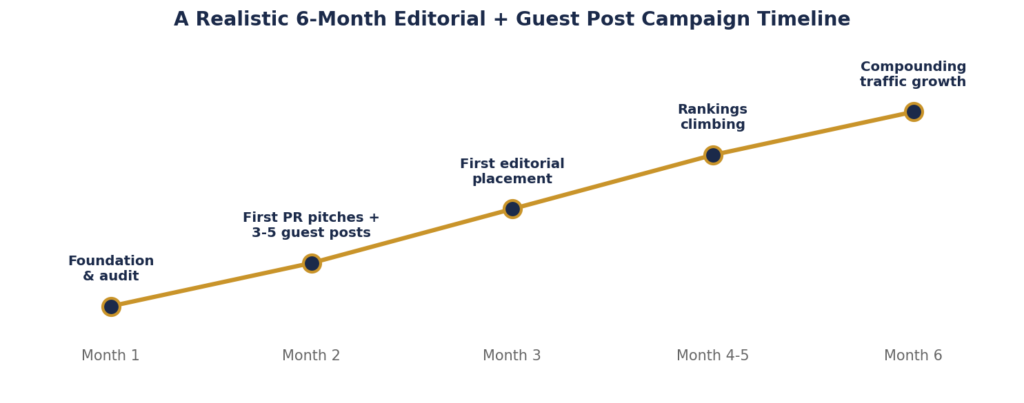
Current healthcare link building analysis offers a specific, useful month-by-month reference timeline worth adapting for medical malpractice specifically. Month one focuses on foundation and audit work — reviewing the existing backlink profile, fixing authorship and credentialing gaps on top pages, and claiming directory listings — typically without visible ranking movement yet. Month two sees the first batch of digital PR pitches go out alongside the first three to five guest post placements. Month three often produces the first genuine authority placement — an editorial mention or citation resulting from either query response or original research distribution. Months four and five typically show rankings beginning to climb as the combined effect of editorial and guest post work compounds. By month six, compounding organic traffic growth becomes visible as the full campaign’s effects mature together.
This timeline reinforces a point relevant throughout this cluster: medical malpractice link building rewards patience and combined-channel investment over any single fast-acting tactic, and the editorial-versus-guest-post decision works best as a deliberate blend rather than an either-or choice.
How This Connects to Evaluating a Link Building Provider’s Approach
Given how decisively current healthcare link building analysis favors editorial and digital PR over standard guest posting for this specific niche, this comparison offers a useful diagnostic for evaluating any prospective link building provider or brokerage. A provider whose healthcare or medical malpractice offering centers primarily on productized, volume-based guest post packages — rather than genuine digital PR, editorial pitch work, or original research support — is applying an approach current guidance suggests is increasingly treated as a supporting tactic rather than this niche’s primary lever.
This doesn’t mean a provider offering guest posting is automatically the wrong choice — as covered throughout this guide, guest posting remains genuinely valuable as part of a blended approach. But a provider unable to speak to digital PR, editorial outreach, or original research support at all, offering only guest post placement, is covering a narrower slice of what current best practice suggests this specific niche actually requires for competitive results.
How to Weight the Blend as a Firm Matures
Consistent with the broader growth-stage framework relevant to editorial-versus-guest-post weighting generally, a newer medical malpractice firm should lean more heavily on guest posting initially, since editorial coverage — particularly the original-research tactic covered above — typically requires more existing credibility and resources to execute well. As a firm matures and accumulates genuine case experience worth analyzing, real press relationships, and stronger overall content depth, the original research and broader digital PR tactics become increasingly accessible and should represent a growing share of new link acquisition, given how much more heavily this specific niche’s YMYL evaluation weighs genuine editorial validation over contributed content.
A Worked Example: Turning Case Data Into Original Research
Making the original-research tactic concrete helps more than the principle alone. Consider a firm with two years of case experience specifically in surgical error claims, having handled a genuinely meaningful number of matters in this category. Rather than treating this experience purely as case history, the firm could aggregate and anonymize patterns across these matters — average time from initial consultation to case resolution, common types of surgical errors represented in their caseload, or general observations about how insurance carriers have approached settlement in this specific case type.
Presented honestly, with clear methodology notes acknowledging the data reflects one firm’s caseload rather than a comprehensive industry study, this becomes a genuinely citable resource. A health journalist researching a story on surgical error patterns, or a patient safety publication covering settlement trends, now has an original, specific data point to reference and link to — something that didn’t exist in this form before the firm published it. This is a meaningfully different, more durable asset than a single guest post pitch, since it can be referenced repeatedly over time by multiple publications rather than producing a single placement.
Common Mistakes Firms Make With Editorial and Original Research Tactics
Presenting case-derived data without adequate methodology transparency. A firm publishing aggregate case pattern data without clearly explaining its scope and limitations — how many cases, over what period, what firm-specific factors might affect the pattern — risks both compliance concerns and reduced credibility with journalists evaluating whether to cite the work.
Treating original research as a one-time project rather than an ongoing content asset. A firm that publishes original research once and moves on misses the compounding value of building this into a recurring practice — an annual or semi-annual update to the same research, tracking how patterns shift over time, tends to earn renewed citation interest each time it’s refreshed.
Pursuing original research before a firm has genuine case volume to draw meaningful patterns from. A newer firm with limited case history attempting this tactic risks producing thin, unconvincing data that undermines credibility rather than building it — this tactic genuinely does work better for firms with several years of case experience to draw from.
Assuming original research replaces the need for genuine outreach. Publishing original data doesn’t guarantee it gets discovered and cited — pairing original research with genuine, targeted outreach to relevant journalists and publications significantly improves the odds it actually produces the editorial coverage this tactic is meant to generate.
Compliance Considerations Specific to Original Research
Publishing original research derived from a firm’s own case experience intersects with attorney advertising and client confidentiality rules in ways worth reviewing before publication. Aggregate, properly anonymized case pattern data generally poses lower risk than anything that could identify specific clients or matters, but the specific line between acceptable aggregate analysis and problematic case-specific disclosure varies by jurisdiction and should be reviewed against a firm’s specific state bar rules and any relevant client confidentiality obligations before publishing.
This is genuinely worth a brief compliance review rather than assuming aggregate data is automatically safe — some jurisdictions have specific rules around discussing case outcomes or settlement patterns in marketing content, even in aggregated form, making this an area where upfront diligence protects against a much costlier correction after publication.
Frequently Asked Questions
Should a medical malpractice firm prioritize digital PR over guest posting from day one, given how much more editorial links matter in this niche?
Not necessarily from day one — a brand-new firm typically lacks the case experience, press relationships, and content depth that make digital PR and original research genuinely effective, making a guest-post-weighted approach more realistic initially, with digital PR investment growing as the firm matures per the growth-stage framework covered above.
What counts as sufficiently “original” research for the digital PR tactic described in this guide?
Genuinely original means data, analysis, or findings that didn’t exist in this specific form before the firm published them — aggregate patterns from a firm’s own case experience, original survey results, or novel analysis of publicly available data, rather than simply restating or summarizing information already published elsewhere.
How does a firm find journalists or publications interested in original medical malpractice research specifically?
Journalist query platforms remain a useful starting point for distributing original research findings, alongside direct outreach to health and legal reporters who have previously covered similar topics, and submission to medical and legal publications directly, particularly those already covering patient safety or healthcare accountability topics as discussed elsewhere in this cluster.
Is it worth pursuing guest posts on general legal sites that occasionally cover medical malpractice, or only genuinely health-focused publications?
Both have a role, consistent with the tiered relevance framework relevant to evaluating any guest post opportunity — genuinely health-focused or legal-medical intersection publications carry the strongest relevance signal, but well-vetted general legal sites with genuine, if less concentrated, malpractice coverage still contribute real value to a diversified backlink profile.
How much does executing genuine original research typically cost compared to a standard guest post campaign?
This varies considerably by scope — a modest client survey or aggregate case-pattern analysis can be executed with primarily internal time investment rather than significant additional budget, while more ambitious original research involving external data collection or a formal research partnership represents a larger investment, generally justified only once a firm has the case volume and resources to make the resulting research genuinely substantive.
Does the elevated editorial-versus-guest-post weighting for healthcare apply equally to all medical-legal content, or does it vary by specific malpractice sub-topic?
The underlying principle applies broadly across medical malpractice content, though sub-topics with more inherent newsworthiness — emerging medical error patterns, notable local cases, or timely healthcare policy developments — tend to create more natural digital PR and original research opportunities than less newsworthy, more procedural malpractice topics, making the editorial-weighting case even stronger for firms with genuinely newsworthy expertise to offer.
Should a firm track editorial and guest post placements using the same success metrics, or does this healthcare-specific weighting change how results should be measured?
The general principle of measuring each channel differently — placement volume and consistency for guest posts, pickup rate and brand mention volume for editorial and digital PR — still applies, though given healthcare’s outsized editorial impact, firms should weight editorial pickup rate and resulting citation quality more heavily in their overall success evaluation than they might for a less YMYL-sensitive practice area.
Can original research be repurposed into guest post content as well as pitched for editorial coverage?
Yes, and this is a genuinely efficient way to extract more value from the underlying research investment — a firm can pitch the original findings to journalists for editorial coverage while also using the same data as the foundation for a deeper, guest-post-length article submitted to relevant publications, provided each piece offers a genuinely distinct angle rather than duplicating identical content across multiple placements.
How does a firm decide between conducting original client survey research versus analyzing its own existing case data?
Existing case data analysis is generally more accessible, since it doesn’t require new data collection, but genuinely original client or public survey research can produce findings a firm’s own case history alone couldn’t offer — broader awareness or attitude data, for instance. Firms with limited case volume but genuine subject-matter expertise may find survey-based research more viable than case-pattern analysis, while firms with substantial case history may find their own data the more efficient starting point.
Why This Matters Beyond Traditional Rankings
It’s worth closing with a point that runs throughout this cluster in different forms: the editorial-over-guest-post weighting covered in this guide matters not just for traditional search rankings but for AI-driven visibility as well. Genuine brand mentions earned through editorial coverage and original research correlate more strongly with AI citation likelihood than backlinks alone, meaning a firm investing in the tactics this guide emphasizes is building visibility across both traditional search and the growing share of prospective client research happening through AI-generated summaries — a dual benefit that a purely guest-post-focused strategy captures only partially.
The Bottom Line
For medical malpractice specifically, the editorial-versus-guest-post decision tilts more decisively toward editorial coverage than it does for general personal injury or lower-scrutiny legal niches, given how directly YMYL evaluation rewards the genuine third-party validation editorial links provide. Guest posting remains a valuable, necessary supporting tactic — particularly for newer firms still building foundational credibility — but the original research and digital PR tactics covered in this guide, especially the practice of publishing genuinely original data or analysis as citable bait, represent a distinctly healthcare-specific opportunity most firms treating this as a generic legal link building decision never fully capitalize on.