How to Build Links for a Brand New Medical Malpractice Firm Website
A single quarterly article in a state bar journal generates more E-E-A-T value than 50 blog posts published on a firm’s own website. That’s a genuinely useful, if slightly humbling, fact for a brand-new medical malpractice firm to internalize early, because it points directly at the core problem this guide addresses: a new domain starts with zero content history and zero backlinks, and in a niche stacking both legal and health YMYL scrutiny simultaneously, that zero-authority starting point is a steeper climb than in almost any other legal practice area.
This guide covers the actual sequence a brand-new medical malpractice firm website should follow to build genuine link authority from nothing, why early links matter disproportionately more than they will later, and the specific tactics worth prioritizing in the first several months.
Why Zero Authority Hits Harder for Medical Malpractice Specifically
Every new website starts without content history or backlinks, but medical malpractice’s double YMYL classification — both legal and health scrutiny applied simultaneously — means Google’s quality evaluation requires more evidence of genuine trustworthiness before extending confidence to a new domain, compared to lower-stakes practice areas. Establishing this trust simply takes longer here than it does for a new general business site, and rushing the sequence tends to backfire rather than accelerate results.
This isn’t a reason to avoid launching aggressively — it’s a reason to understand that the foundational stages matter more, and take proportionally longer to properly establish, than they would for a firm handling a less scrutinized practice area.
Why Early Links Matter More Than They Will Later
Here’s a technical point worth understanding before diving into tactics: each backlink a domain earns strengthens the entire domain, not just the specific page that received the link, making it easier for every page on the site to rank — not only the linked page itself. For a brand-new site with only a handful of pages, this means early, genuinely high-quality links have outsized impact relative to what the same links would contribute to an already-established site with dozens of existing pages competing for that same authority boost.
This is a real, practical argument for prioritizing quality over speed in a new site’s first several links specifically. A single genuinely strong early link — from a state bar journal, a .edu scholarship page, or a genuine patient advocacy partnership — does more relative work for a three-page site than the same link would for a mature, 200-page domain.
The Realistic Starting Sequence
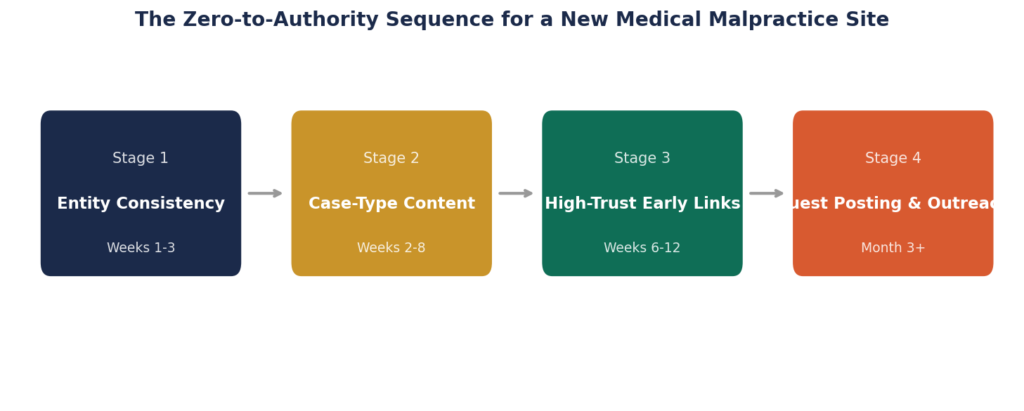
Stage 1: Foundational Entity Consistency (Weeks 1-3)
Before pursuing any earned links, establish the baseline entity consistency search systems and directories cross-reference against: Google Business Profile fully completed, the core legal directories (Avvo, Justia, FindLaw, Martindale-Hubbell) claimed with complete, consistent NAP data, and state bar record accuracy confirmed. Inconsistencies between a website and these directory profiles — different addresses, missing attorneys, outdated practice areas — actively undermine the trust signals this stage is meant to establish, so accuracy matters more than speed here.
Stage 2: Genuine Case-Type Content (Weeks 2-8)
Given how much medical malpractice’s E-E-A-T evaluation depends on demonstrated genuine expertise, this stage deserves more time and depth than the equivalent stage would for a lower-stakes practice area. Building real, substantive case-type content — genuinely covering surgical errors, birth injuries, misdiagnosis, and other relevant categories with real depth, not template-level overviews — gives both search systems and prospective outside link sources something worth citing.
This stage shouldn’t be rushed to hit a page count. A smaller number of genuinely thorough, expert-level pages does more to establish the credibility needed for the next stages than a larger number of shallow ones.
Stage 3: Low-Barrier, High-Trust Early Links (Weeks 6-12, overlapping Stage 2)
Once foundational entity consistency and initial content depth exist, a few tactics become accessible even for a domain with essentially no existing authority.
A scholarship program is worth serious consideration as a first move specifically. A modest scholarship — commonly in the $500-1,000 range — tied to a relevant field and submitted to university financial aid offices, earns a genuine .edu backlink that current guidance describes as capable of outweighing dozens of average links, while carrying essentially zero compliance risk given it’s a legitimate charitable activity rather than a marketing transaction. For a brand-new domain specifically, this kind of institutional link does outsized work given the domain-wide authority spillover covered above.
Unlinked brand mention recovery remains accessible even for a new firm, since it depends on the firm or its attorneys being mentioned anywhere online without a link, not on the domain’s existing authority.
State bar journal contribution deserves priority given the specific claim opening this guide — a single genuine bar journal article can outweigh dozens of standard blog posts in E-E-A-T value, and bar publications generally evaluate contributions on genuine expertise and standing within the profession rather than a submitting domain’s existing authority metrics, making this channel genuinely accessible even to a new firm.
Stage 4: Guest Posting and Medical-Adjacent Outreach (Month 3 onward)
Once Stages 1 through 3 have established genuine foundational trust and some initial high-quality links, guest posting and outreach to medical-adjacent publications become realistic — an editor reviewing a pitch now sees a site with genuine content depth and some outside validation already established, rather than an empty domain with nothing to point to.
A Worked Example: A New Firm’s First Ninety Days
Making this concrete helps more than the stage structure alone. Consider a two-attorney medical malpractice firm launching a new website in a mid-sized market, with a modest initial marketing budget and no prior online presence.
Weeks 1-3: The firm claims and fully completes Google Business Profile, Avvo, Justia, and FindLaw, confirming consistent NAP data across each. State bar record accuracy is verified. No content or link work begins yet beyond this foundational layer.
Weeks 2-8, overlapping: One attorney begins drafting genuine, detailed case-type content — starting with birth injury and surgical error pages specifically, since these represent the firm’s actual case experience, rather than attempting broad coverage across every possible malpractice category from day one. Each page takes real research and drafting time rather than being rushed to hit a launch deadline.
Around week 6, the firm launches a $750 scholarship specifically for pre-med or nursing students, submitting it to a dozen relevant university financial aid offices in its state. By week 10, three universities have added the scholarship to their aid pages, producing three genuine .edu backlinks pointing at the firm’s new, still-thin domain — links that, per the domain-wide spillover effect covered above, immediately strengthen every page on the site, not just the scholarship page itself.
Simultaneously, the firm’s managing partner reaches out to the state bar association’s publications committee about contributing an article on a recent development in medical malpractice standard-of-care litigation relevant to the state. The article is accepted and published in month three, producing the single highest-value link the firm has earned to date — consistent with the claim opening this guide about bar journal contributions outweighing dozens of standard blog posts in E-E-A-T value.
By month three, with genuine case-type content depth established and these initial high-trust links in place, the firm begins pursuing guest posting and outreach to medical-adjacent publications with a genuinely stronger foundation to point to than it had at launch — exactly the sequence this guide describes, executed on a realistic budget and timeline.
Common Mistakes New Firms Make in This Sequence
Skipping the scholarship tactic because it feels indirect compared to a straightforward guest post purchase. This is precisely the mistake worth avoiding given the domain-wide spillover effect — a modest scholarship investment often outperforms a similarly-priced guest post placement specifically because of how much more relative impact a genuine .edu link has on a new, thin domain.
Launching case-type content for every possible malpractice category simultaneously rather than starting with the firm’s actual case experience. A new firm attempting comprehensive coverage from day one typically produces shallower content across more pages than the same effort concentrated on two or three genuinely deep pages reflecting real practice focus.
Treating bar journal contribution as too slow or bureaucratic to pursue early. While the submission and publication process does take real time, starting this outreach in the first month rather than waiting until later means the resulting link and E-E-A-T value arrives sooner, compounding with the domain’s overall authority-building timeline rather than being pushed to a later stage unnecessarily.
Assuming Stage 4’s guest posting can be accelerated by simply paying more for higher-authority placements immediately. A domain with no content history and no prior links faces genuine editorial skepticism regardless of budget — this is a trust problem that money alone doesn’t solve as efficiently as following the sequence’s earlier stages first.
What to Avoid at Each Stage
Don’t pursue bulk, cheap guest post packages before Stage 2’s content depth is genuinely established — a backlink pointing at a thin site has little supporting context to reinforce, and this risk is proportionally larger given medical malpractice’s elevated scrutiny. Don’t rush Stage 1’s entity consistency work to reach later stages faster — inconsistencies established early tend to persist and require correction later, costing more time than getting it right initially would have. Don’t chase high-authority guest post placements in the first month regardless of budget — an editor evaluating a pitch from a domain with no content history and no other links has real reason for skepticism that even a compelling pitch may not overcome.
Why Budget-Constrained Firms Should Prioritize Effort Over Spend Early On
For a new firm operating with limited marketing budget — which describes most newly launched practices — this sequence’s emphasis on the scholarship program and bar journal contribution is genuinely good news rather than just a compliance-safe recommendation. Both tactics depend more on genuine time investment and modest, well-directed spending than on the larger budgets aggressive guest posting or digital PR campaigns typically require.
This means a resource-constrained new firm isn’t meaningfully disadvantaged relative to a better-funded competitor during these critical first several months, provided it’s willing to invest the genuine effort these tactics require — drafting a real bar journal article, following through on university scholarship submissions — rather than assuming budget is the primary constraint on early link building success. The firms that struggle most in this early period tend to be the ones skipping these lower-cost, higher-effort tactics in favor of waiting until budget allows for guest posting, rather than recognizing that the most valuable early moves in this specific sequence don’t actually require large spend to execute well.
A Realistic Timeline
Firms following this sequence typically complete foundational entity consistency within 2-3 weeks, establish genuine initial case-type content depth by weeks 6-8, and see their first high-trust links (scholarship, bar journal, or recovered mentions) land somewhere in the second or third month. New links typically take four to eight weeks for search systems to process and incorporate before any ranking impact becomes visible, meaning a realistic total timeline from launch to first measurable ranking movement runs roughly five to six months for medical malpractice specifically — longer than the equivalent timeline for a lower-stakes legal practice area, reflecting the double YMYL scrutiny covered throughout this guide.
Frequently Asked Questions
Should a brand-new medical malpractice firm launch its scholarship program immediately, or wait until other foundational work is complete?
A scholarship program can reasonably launch early, in parallel with Stage 1’s entity consistency work, since it doesn’t depend on existing domain authority to succeed — submitting to university financial aid offices works the same whether a domain is brand new or well-established.
How much should a new firm budget for its first three months of link building specifically?
A scholarship program at $500-1,000 represents a reasonable, high-value initial investment, and beyond that, the first three months should weight time investment (bar journal contribution, content development, entity consistency work) over direct link-purchase spending, since the highest-value early tactics covered in this guide depend more on genuine effort than budget.
Is it worth pursuing guest posting in the first month, even at a modest scale?
Generally not as a primary strategy — a domain with no content history and no other established links faces real skepticism from editors evaluating a guest post pitch, and the same effort typically produces better results once Stages 1 through 3 have established some genuine foundational credibility first.
How does a new firm identify a genuine bar journal contribution opportunity?
Most state and many local bar associations publish member journals or newsletters accepting article submissions from practicing attorneys, typically found through the bar association’s own website or by contacting their communications or publications committee directly — this is generally accessible to any licensed attorney in good standing, regardless of firm size or domain age.
Does the domain-wide link equity spillover effect mean a new firm should link internally from every page to its strongest new backlink’s target page?
Not directly — the spillover effect works through the domain’s overall authority strengthening, not through internal link engineering pointing at one specific page. Genuine internal linking following the descriptive, topic-relevant approach relevant to any site’s internal structure remains the right practice, rather than artificially concentrating internal links toward wherever an external link happens to point.
How long should a new firm wait before pursuing more aggressive, higher-volume link building once the foundational stages are complete?
Once Stages 1 through 3 are genuinely established — not just attempted, but showing some initial results like a completed scholarship link and bar journal placement — moving into Stage 4’s guest posting and broader outreach becomes appropriate, typically somewhere around the three-month mark for a firm executing this sequence consistently.
Is this sequence meaningfully different from the general zero-authority link building approach relevant to any new legal practice area?
The underlying stage structure is similar, but medical malpractice specifically warrants more time and depth at each stage given its double YMYL classification, and the scholarship and bar journal tactics carry outsized relative value here given how heavily this niche’s E-E-A-T evaluation weighs genuine institutional and professional validation compared to lower-scrutiny practice areas.
Can a scholarship program and a bar journal contribution be pursued simultaneously, or should they be sequenced one after the other?
They can and generally should run in parallel, since they draw on different resources — the scholarship primarily requires budget and administrative follow-through with university financial aid offices, while the bar journal contribution requires an attorney’s time and subject-matter expertise. Pursuing both simultaneously, rather than sequentially, gets a new firm to Stage 3’s high-trust link milestones faster than treating them as sequential tasks would.
What should a new firm do if its first scholarship submission attempt gets little or no university response?
Persistence and volume matter here — submitting to a broader range of relevant universities, including smaller or regional institutions that may be more responsive than large, high-volume schools, and following up after an initial submission rather than assuming silence means rejection, typically improves response rates meaningfully over a single narrow attempt.
How This Foundation Pays Off Beyond the First Six Months
It’s worth noting that the work described in this guide isn’t purely a one-time launch phase, disconnected from a firm’s longer-term link building strategy. The genuine case-type content built in Stage 2 becomes the foundation the firm’s ongoing content and link building efforts build on for years, not just something to establish and move past. The relationships developed through bar journal contribution and any patient advocacy outreach pursued alongside it often become recurring, durable channels rather than one-time wins — a firm that contributes once to its state bar journal and does it well is well-positioned to contribute again, compounding the E-E-A-T value this channel provides over time rather than treating it as a single early milestone to check off and forget.
The Bottom Line
A brand-new medical malpractice firm’s link building sequence isn’t fundamentally different in structure from any new legal domain’s — foundational consistency first, genuine content depth second, high-trust early links third, broader outreach once credibility exists. What’s different is the stakes: double YMYL scrutiny means each stage deserves more time and rigor than a lower-stakes practice area would require, but it also means the highest-value early tactics — a modest scholarship program, a genuine bar journal contribution — carry outsized relative impact for a thin, new site given how directly domain-wide authority spillover works. Firms that respect this sequence, rather than rushing toward guest posting and broader outreach before the foundation genuinely exists, build a backlink profile that actually withstands the scrutiny this practice area’s ranking systems apply most rigorously.