
POST 21 – Guest Posting for Law Firms (Medical Malpractice Edition)
Guest posting has been declared dead more than once, and yet it is still one of the most common ways law firms earn links from other websites. Both things can be true because “guest posting” covers two very different practices: publishing genuinely useful content on a relevant site, and mass-producing sponsored articles to carry keyword-stuffed links.
For a medical malpractice firm the difference matters more than for most. Your content touches health and legal outcomes, your audience is making a high-stakes decision, and the sites you appear on shape how credible you look. This guide explains what guest posting for law firms means today, what Google tolerates, and how to do it safely.
What guest posting means for a law firm
Guest posting is writing an article for another website and receiving a credited link back to your own. For law firms it usually takes one of two forms.
- Author-led thought leadership. A partner writes a piece for a legal or healthcare publication, and the byline and author bio carry the link. The goal is reputation first, links second.
- Placement-led link building. A provider arranges a relevant article on a publisher’s site, often with a link inside the body. The goal is a backlink from a credible, topically relevant domain.
The first works through expertise. The second works through relevance and editorial standards. Most of the confusion, and most of the risk, comes from treating the second like a volume game.
Does guest posting still work?
Yes, when it is done on relevant sites with real editorial standards. The trade press has said this for years. One legal marketing consultant wrote that guest posting remains a solid way to generate backlinks and improve rankings if used wisely, even though spammers have tainted the practice (Law Quill on Above the Law). Another law firm marketer made the same point from a local-link angle: guest posting for backlinks can work, but law firm SEO companies have damaged it for everyone (Attorney Sync).
Where it stops working is at scale and on autopilot. Google’s spam guidance on link schemes treats large guest posting campaigns with keyword-rich anchor text as a problem, and a law firm SEO article summarizing those rules flags exchange for money, keyword-rich anchors and automated link propagation as the practices to avoid. In practice this means:
- A single credible placement on a relevant publication is low risk.
- Fifty near-identical articles on unrelated blogs is high risk.
- Paid placements should be handled according to Google’s guidance on paid links, which is why disclosure and attribution deserve a conversation with your provider.
We expand on this distinction in editorial links vs guest posts for medical malpractice firms
Why medical malpractice raises the bar
Accuracy matters more. A guest post that mischaracterizes a medical standard of care, a limitation period or a procedure reflects on you and can mislead readers. Content should be reviewed by someone qualified to review it.
Relevance is narrower. A generic business blog adds little in this category. Healthcare law, patient safety, legal industry and credible local publications are better fits, because the link sits in content a reader would genuinely expect to find there.
Advertising rules apply. Attorney advertising and solicitation rules vary by jurisdiction, and content that promotes your firm can fall within them. Check your state bar’s rules before approving anything with a promotional tone.
Reputation travels with the placement. Readers, referral sources and journalists see where you appear. A thin sponsored page on a site that publishes anything for a fee does not help.
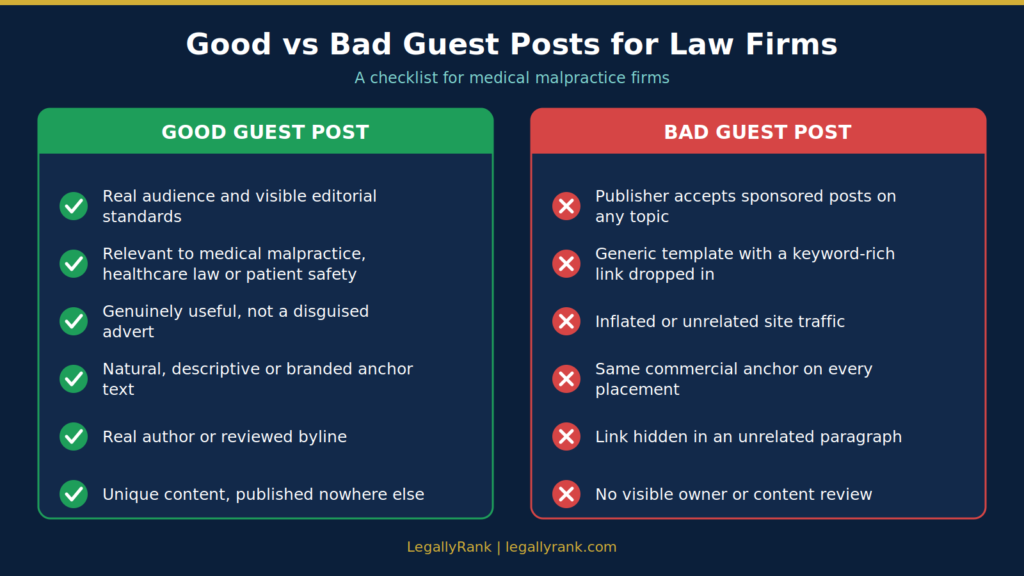
What a good guest post looks like
- It sits on a site with a real audience and visible editorial standards
- It is topically relevant to medical malpractice, healthcare law, patient safety or the legal profession
- It offers something useful, such as an explanation, a data point or a clear how-to, rather than a thinly disguised advert
- The link is natural, with descriptive or branded anchor text, and points to the page that deserves it
- It carries a real author or reviewed byline
- It is not duplicated anywhere else
What a bad guest post looks like
- The publisher accepts sponsored content on any topic
- The article is a generic template with a keyword-rich link dropped in
- The site has traffic that looks inflated or unrelated to its subject
- The anchor text is the same commercial phrase on every placement
- The link is hidden in an unrelated paragraph
- There is no way to see who runs the site or reviews content
Our walkthrough on auditing a medical-legal guest post site before you buy shows how to check these points in a few minutes, and our guide to anchor text strategy for medical malpractice firms covers the anchor side.
Where medical malpractice firms can guest post
Rather than a list of named sites, think in categories and test each against the checks above:
- Legal industry publications and blogs that accept expert contributions
- Healthcare law and patient safety outlets where your topic is directly relevant
- Local news and community publications that serve the area you practice in, which suits the local relevance point made by Attorney Sync
- Professional association and bar-affiliated blogs that publish member contributions
- Industry-adjacent publications such as healthcare administration or insurance commentary, when your angle fits
A simple process that keeps risk low
- Set the goal. Decide whether the priority is reputation, links to a specific case-type page, or both.
- Shortlist relevant publishers and run the audit checks before any outreach or payment.
- Pitch an angle, not a link. Editors respond to a useful idea with a clear audience benefit.
- Write for the reader. Keep it accurate, specific and free of sales language.
- Have it reviewed by a qualified person before it goes live.
- Choose the anchor and target page deliberately, usually descriptive or branded anchors pointing to the most relevant case-type page.
- Record each placement with the live URL, date, anchor and target page.
- Keep volume modest and steady instead of publishing a burst of articles.
Prefer to have vetted placements arranged for you? LegallyRank is a specialist legal link building broker. See our link building services.
How to tell if guest posting is working
Check Google Search Console for impressions and position changes on the pages you linked to, track referring domains gained, watch referral traffic from each placement, and note any increase in branded search. As we explain in our wider guide to link building for law firms, the real measure is qualified enquiries, which tend to move last.
Frequently Asked Questions
Does guest posting for law firms still work?
Guest posting for law firms still works when the articles appear on relevant sites with real editorial standards and use natural anchor text. It stops working, and becomes risky, when it is done at scale on low-quality sites with keyword-stuffed links.
Is guest posting safe for law firms?
Guest posting is safe for law firms when placements are few, relevant and editorially credible, and risky when it relies on mass-produced sponsored articles. Using descriptive or branded anchors and following Google’s guidance on paid links reduces the risk.
How is guest posting different for medical malpractice firms?
Guest posting for medical malpractice firms needs higher accuracy and tighter relevance because the content touches health and legal outcomes. Placements on healthcare law, patient safety and credible legal or local publications carry more value than generic business blogs.
Should a lawyer write the guest post themselves?
A lawyer should write or at least review the guest post whenever it makes legal or medical claims, because accuracy and the author’s credibility are central to its value. A provider can draft it, but a qualified person should approve it before publication.
How many guest posts should a law firm publish?
A law firm should publish guest posts at a modest, steady pace rather than in a burst, because a few relevant placements each month look more natural than many at once. The right number depends on your starting point and competition.
Do guest posts need to be labelled as sponsored?
Guest posts that involve payment should be handled according to Google’s guidance on paid links and applicable advertising rules, which usually means appropriate disclosure and link attribution. Ask your provider how they handle this before you commit.