
Link Building ROI for Medical Malpractice Firms: How to Measure It in 2026/27
“What is the return on link building?” is the question every firm eventually asks, and the honest answer is that it is harder to measure than almost any other marketing spend. Links do not convert visitors directly. They raise the authority of pages that then rank, attract enquiries and, much later, become signed cases.
For a medical malpractice firm the gap between the first link and the first fee can be long. This guide shows how to measure link building ROI in a way that is honest about that delay, from the first leading indicators through to signed matters.
Why measuring link building ROI is different
Generic ROI guides give a simple formula. One link building guide states it as revenue attributed to link building, minus the cost of link building, divided by that cost, multiplied by 100 (Mavlers). A law firm SEO guide applies the same logic at the SEO level, giving an example where a firm spending $5,000 a month and generating $25,000 in new case revenue from organic leads has an ROI of 400% (On The Map Marketing).
The formula is fine. The difficulty is filling in the numbers for a medical malpractice firm:
- Attribution is indirect. Links support rankings, which support enquiries. No single enquiry says “I came because of that backlink.”
- The cycle is long. Medical malpractice matters often take a long time from enquiry to resolution, so revenue can lag spend by a year or more.
- Most enquiries do not become cases. Medical malpractice matters need merit and expert support, so firms typically screen out a large share of enquiries. Enquiry volume alone overstates results.
- Link building is bundled with other work. Content, technical fixes and local SEO move rankings at the same time.
Measure in three layers
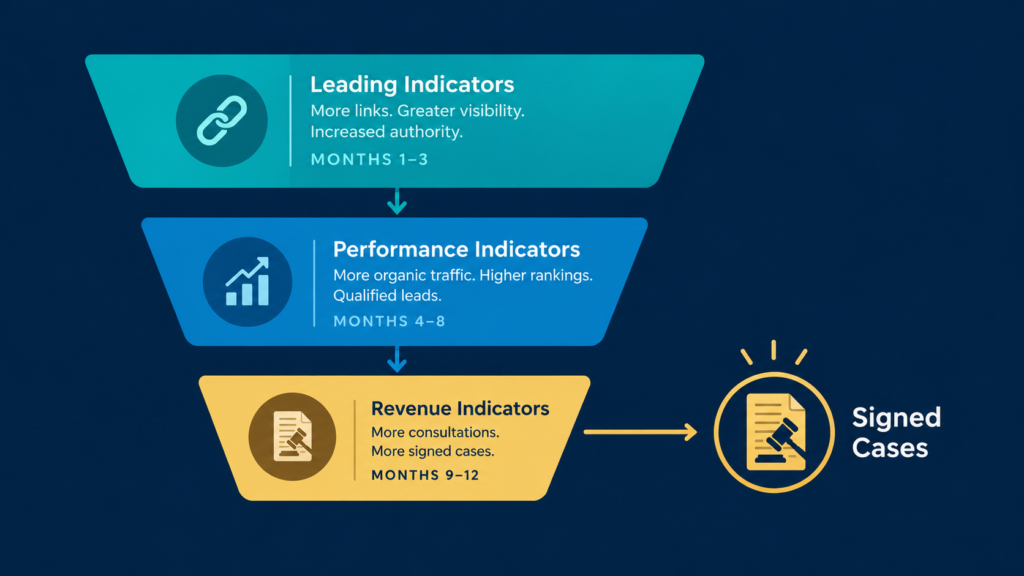
Because revenue arrives late, track three layers of metrics and look at them together.
Layer 1: Leading indicators (months 1-6)
These tell you the links are working before revenue shows up.
- Referring domains gained, and how many are relevant to law, healthcare or your local area
- Indexed status of each placement
- Impressions and average position in Google Search Console for the pages you linked to
- Branded search growth, which often rises as authority and visibility build
- Referral traffic from the placements themselves
Layer 2: Performance indicators (months 4-12)
These show the links are turning into demand.
- Organic sessions to case-type pages such as surgical error, misdiagnosis and birth injury
- Contact form submissions and tracked phone calls from organic search
- Qualified enquiries, meaning those that pass your intake screening
- Ranking movement for the specific case-type queries you care about, not only the head term
Layer 3: Revenue indicators (months 9 and beyond)
These close the loop.
- Signed cases that originated from organic search
- Expected or realized fees attached to those cases in your CRM
- Cost per signed case compared with other channels
A simple illustrative calculation
The numbers below are made up to show the method. They are not benchmarks.
| Item | Illustrative value |
|---|---|
| Link building spend over 12 months | $36,000 |
| Organic enquiries to linked pages | 60 |
| Passed intake screening | 9 |
| Signed cases | 3 |
| Average expected fee per case | $60,000 |
| Projected fees | $180,000 |
| Projected ROI | (180,000 − 36,000) ÷ 36,000 × 100 = 400% |
Two cautions apply. First, these are projected fees, not collected ones, so label them that way when you report them. Second, the result belongs to the whole organic program, not to links alone. If you want a link-specific view, compare pages that received links with comparable pages that did not.
How to set up tracking so the data exists
Most of the pain in ROI reporting comes from not capturing the data at the time. Set up these basics early:
- Google Search Console to monitor impressions, clicks and position by page.
- Google Analytics 4 with key events for form submissions and calls, so organic enquiries are counted.
- Call tracking that records the source of phone enquiries.
- A “how did you hear about us” field on the intake form and in the intake script, since it often reveals offline and mixed paths.
- CRM source fields that carry the original channel through to signed case and fee.
- A placement log recording the date, publisher, anchor text, target page and cost for each link. Our guide on how to audit a medical-legal guest post site before buying shows what to record about each publisher.
What not to use as ROI
- Domain authority or domain rating are quality checks on a publisher, not outcomes.
- Number of links says nothing about relevance or effect. See how many backlinks a medical malpractice firm needs for why volume misleads.
- A single head-term ranking can miss gains on the case-type pages that actually produce enquiries.
- Raw enquiry counts without screening, because they overstate value in this practice area.
Is link building always the best use of budget?
Not always. One law firm SEO practitioner argues that for the large majority of firms, other more glaring needs offer more upside, more quickly, than traditional link building (GNGF). That is a reasonable challenge. If your service pages are thin, your site is slow or your local profile is incomplete, fix those first, because links amplify what is already there.
Cost matters too. Our breakdown of guest posting vs digital PR cost for medical malpractice firms helps you compare the cost side of the equation before you commit.
Want a measurement plan built into your link building from day one? LegallyRank is a specialist legal link building broker. See our link building services.
A practical reporting rhythm
- Monthly: referring domains, placements, impressions and position movement
- Quarterly: organic sessions and enquiries to linked pages, plus a screening-adjusted enquiry count
- Every six to twelve months: signed cases and projected or realized fees from organic search
Report all three together, so a slow quarter on revenue is read alongside healthy leading indicators instead of in isolation. For the wider strategy, see our complete guide to link building for law firms.
Frequently Asked Questions
How do you measure link building ROI?
You measure link building ROI by subtracting the cost of link building from the revenue attributed to it, dividing by the cost and multiplying by 100. In practice you track leading indicators first, then enquiries to linked pages, then signed cases and fees.
How long does it take to see ROI from link building for a medical malpractice firm?
Leading indicators such as new referring domains and impressions often show within three to six months, while revenue can take a year or more to appear. Medical malpractice matters often have long timelines from enquiry to resolution, so fee data arrives late.
What metrics should a law firm track for link building?
A law firm should track referring domains gained, impressions and average position for linked pages, branded search growth, qualified enquiries and signed cases. Together these show progress from links to revenue.
Can you attribute a signed case to a specific backlink?
You usually cannot attribute a signed case to a specific backlink, because links work by raising page authority and rankings rather than driving a single conversion. You can attribute cases to organic search and compare linked pages with similar unlinked ones.
Is domain authority a good measure of link building ROI?
Domain authority is not a good measure of link building ROI, because it estimates a site’s strength rather than your return. It is useful for vetting publishers, but ROI should be measured in enquiries, signed cases and fees.
Is link building worth it for a medical malpractice firm?
Link building is worth it for a medical malpractice firm when the site foundation is sound and the links are relevant and editorially credible, since authority helps case-type pages rank. If service pages are thin or technical issues exist, fix those first.